Abhaneri & Jaipur
Days Eight & Nine - India - 2024
A stop at the captivating stepwell in Abhaneri en route to the beautiful city of Jaipur.
1. Chand Baori #1
Chand Baori -often referred to as the Abhaneri Stepwell after the village it is located in- was dug in the 9th century and draws water from a well 30 meters / 100 feet below ground level.
In addition to some of the mandatory tour requirements I mentioned previously (a visit to Khajuraho, no overnight trains), I also had a very odd, specific need to see Chand Baori, otherwise known as the Abhaneri Stepwell. I had seen a photograph of this strange architectural oddity when I was a child and knew one day I’d just have to see it myself. Thankfully our tour van between Agra and Jaipur would pass right past it and our awesome driver was more than happy to make a quick stop for us. Wow, what a place!
Six more photographs of the stepwell follow.
2. Chand Baori #2
Chand Baori has over 3,500 rock-hewn steps.
3. Chand Baori #3
Despite its massive size, Chand Baori is considered one of the oldest stepwells in India.
4. Chand Baori #4
The incredible number of steps served two purposes: obviously, it allowed more people to get water from the well simultaneously, but it also allowed for the congregation of as many people as possible for religious ceremonies which likely occurred at the site.
5. Chand Baori #5
Chand Baori is laid out in the shape of an inverted pyramid.
6. Chand Baori #6
The temperature at the bottom of the stepwell is 5 degrees Celsius / 10 degree Fahrenheit cooler than at ground level.
7. Chand Baori #7
Chand Baori was likely named after the local ruler at the time of its construction, Raja Chanda.
8. Harshat Mata Temple
Harshat Mata is the goddess of joy, and the temple built to her in Abhaneri likely formed a religious site along with the adjacent Chand Baori.
Before getting on the road, we stopped super quickly at this adjoining temple.
9. Patrika Gate #1
Built between 2016 and 2020, Jaipur’s Patrika Gate is called “the most colorful door in India.”
Upon arrival in Jaipur, we spent some time at the Patrika Gate on the south side of the city. This isn’t an ancient monument; in fact, it was barely ten years old when we visited but was a nice break after a long (four hour) drive.
Nine photos of the gate and the surrounding park follow.
10. Patrika Gate #2
Historically, Jaipur’s city walls had eight gates; as such, this new gate is sometimes referred to as the “Ninth Gate.”
11. Patrika Gate #3
In reference to its unofficial status as the ninth gate, it features nine archways.
12. Patrika Gate #4
The arch sits in Jawahar Circle, a traffic circle of 1400 meters / 4600 feet in circumference in which is also a garden.
13. Patrika Gate #5
Patrika Gate’s colorful paintings make it a very popular (and I mean very popular) location for wedding photographs.
14. Patrika Gate #6
15. Patrika Gate #7
16. Patrika Gate #8
17. Patrika Gate #9
18. Patrika Gate #10
The gate is named after the local media company Rajasthan Patrika, who funded its construction.
19. Jhalana Leopard Reserve #1
Formally the Jhalana–Amagarh Leopard Conservation Reserve, this park opened in 2017 just east of Jaipur; its territory is approximately 3500 hectares / 8700 acres.
It is pretty much a point of pride at this point, but -despite having traveled to several wildlife parks in both Africa and Asia which have them- I’ve never seen a leopard up-close. To try and remedy this, I scheduled us for a visit to Jhalana Leopard Reserve, a small game park literally next to Jaipur’s city center (seriously, you can see apartment blocks at points during the game drive!)
20. Jhalana Leopard Reserve #2
There are two halves to the park -Jhalana and Amagarh- and sits on former royal hunting grounds; the latter contains an 18th century fort (not this - it’s another building….)
It is with tremendous pride that I can say this: despite two hours of valiant efforts on the part of our guide and driver, we did not see a leopard. The streak continues!
After this incredibly predictable disappointment, we checked in at our hotel, the Golden Tulip (another cracker!) for the evening.
21. Hawa Mahal #1
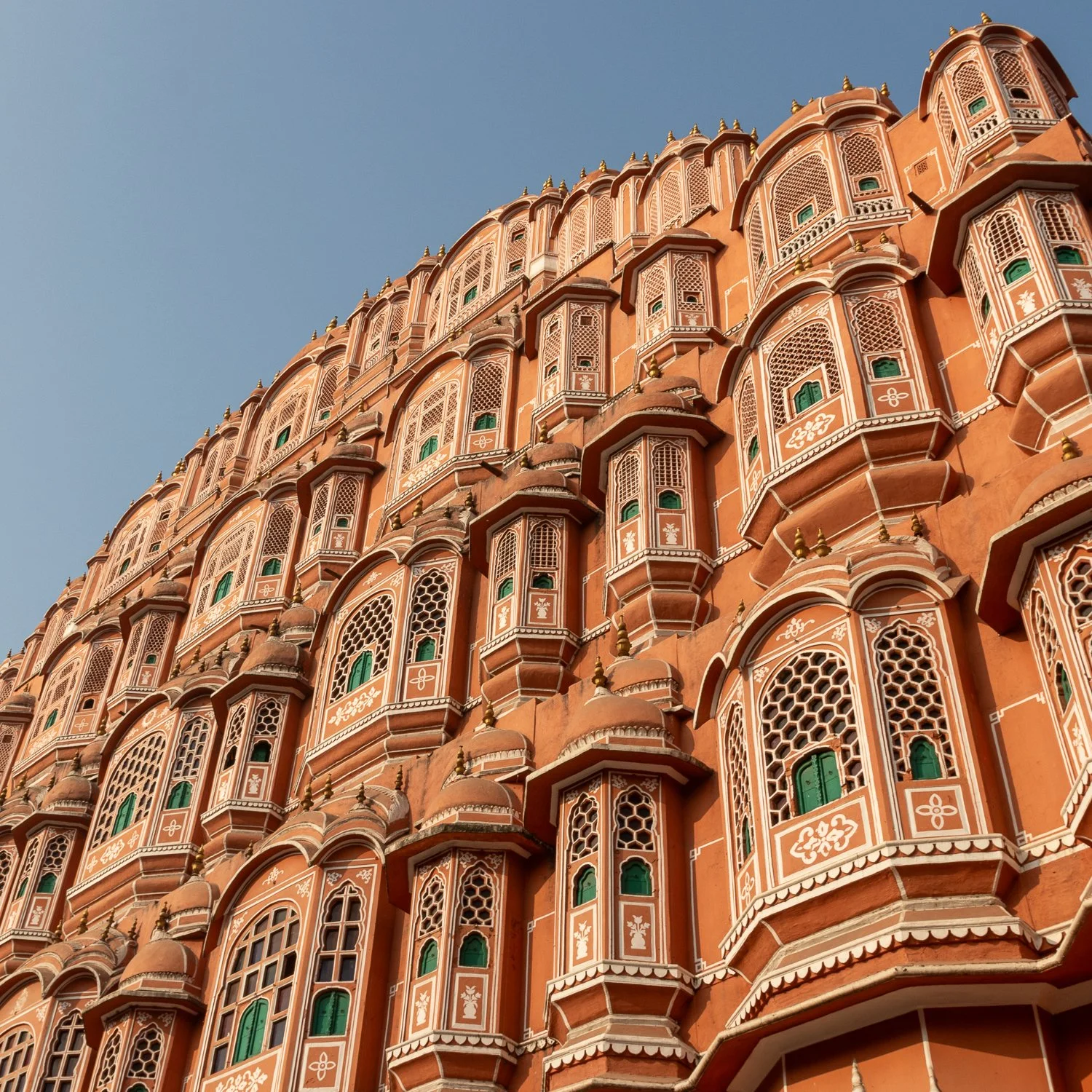
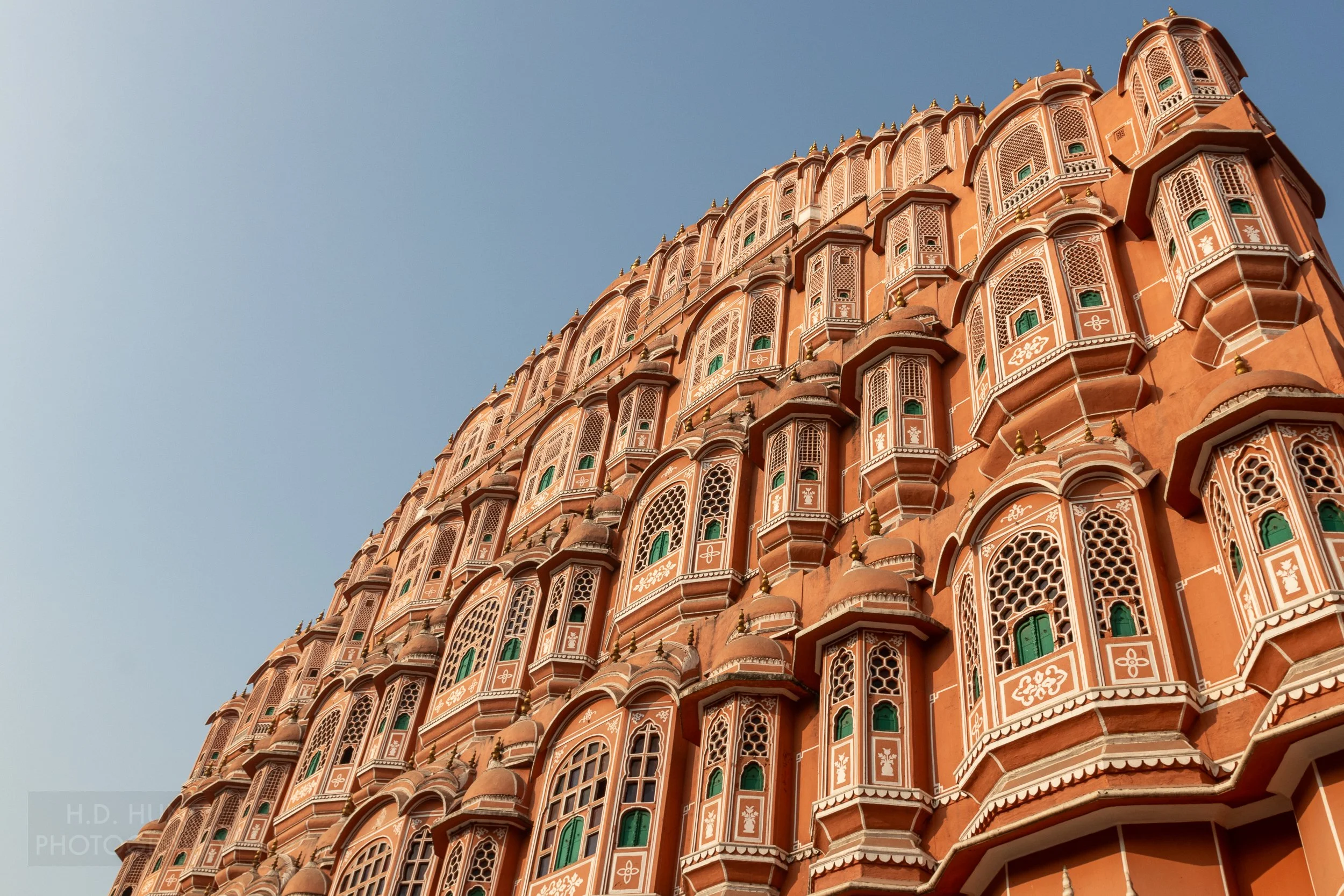
In central Jaipur, the pink sandstone Hawa Mahal was constructed in 1799 and is considered to be one of the most beautiful facades in the world.
The following morning we had a full day tour of Jaipur city, starting with a drive-by of the famous Hawa Mahal facade.
22. Hawa Mahal #2
Containing 953 small stone windows called jharokhas, it allowed female members of the royal court to look outward without being seen; it also allows for cooler air to be pulled into the building, hence the building’s name, “Palace of Winds.”
23. Hawa Mahal #3
While it is certainly a striking architectural feature, the facade is actually at the rear of Hawa Mahal and is not an entrance.
24. Panna Menna Ka Kund
Sitting in the shadow of the Amber Fort in Jaipur’s Amer neighborhood, Panna Menna Ka Kund is a 16th century stepwell; the zig-zag steps are particularly useful here during the monsoon season as the water level rises dramatically, as seen in the change in color of the wall.
After our quick stop, we headed north out of Jaipur to the super massive (and super confusing!) Amber Fort for a walking tour. Beforehand, we stopped quickly at this cute stepwell (at least as compared to Abhaneri’s!) I was also thankful we were dropped off at the top of the hill by van rather than using the more common elephant “taxi” from the base of the fort: while I am by no means an staunch animal rights activist, I choose not to engage in tourist activities which involve direct interaction with kept animals.
20 photographs from our visit to Amber Fort follow.
We run this website for free - show your support with a follow on Instagram!
Thanks for your support!
25. Amber Fort #1
Primarily constructed in the 16th century atop a smaller fort which existed since the 10th century, the massive Amber Fort sits high on a hill in the Jaipur-adjacent village of Amer.
26. Amber Fort #2
It was initially built by Man Singh, Raja of the Kingdom of Amber and prominent military leader under Mughal Emperor Akbar.
27. Amber Fort #3
Amber Fort sits high above Maota Lake, from which it drew its water.
28. Amber Fort #4
Amber is one of six hilltop fortresses built by medieval-era kingdoms in this region, along with Chittorgarh, Gagron, Kumbhalgarh, Jaisalmer, and Ranthambore.
29. Amber Fort #5
Amber Fort is considered an excellent example of so-called “Rajput Architecture,” a term referring to the design style of royal palaces and forts before the British East India Company.
30. Amber Fort #6
When it was expanded in the 16th and 17th centuries, Amber Fort became less of a traditional military fortification and more of a series of palaces, each adorned richly with artwork.
31. Amber Fort #7
While efforts are being led by the Government of India to better protect Amber Fort, some of the interior artwork is faded or in need of repair.
32. Amber Fort #8
Amber Fort’s central charbagh -a square garden divided into four sections divided by four waterways- is impeccably well-maintained.
33. Amber Fort #9
Diwan-i-Khas, or the “Hall of Private Audience” was built in the early 17th century …
34. Amber Fort #10
… Due to the spectacular glass artwork therein, it is sometimes called Sheesh Mahal, or “Glass Palace” …
35. Amber Fort #11
… The upper part of Diwan-i-Khas is known as Jas Mandir …
36. Amber Fort #12
… And here are rooms with highly-reflective glass panels …
37. Amber Fort #13
… As well as intricately-designed stone inlaid walls …
38. Amber Fort #14
… And beautifully carved stone windows.
39. Amber Fort #15
Amber Fort was deliberately designed so that moving between the building’s two courtyards required taking a very specific and non-obvious route …
40. Amber Fort #16
… While choosing one of the many wrong routes would lead to dead-ends, or -worse yet for invaders- awaiting guardsmen.
41. Amber Fort #17
Sukh Niwas, or “Pleasure Palace,” was the private chamber of the raja, notable for its incredibly innovative water-cooled air vent system.
42. Amber Fort #18
The fourth and last of Amber Fort’s courtyards is Zanana, which served as royal quarters for the females of the court …
43. Amber Fort #19
… Which was necessary in Man Singh’s case as he took at least ten wives.
44. Amber Fort #20
Visitors to Amber Fort can be dropped off at the top of the hill by a tour operator, walk up the long, steep, and narrow ramp, or ride up on an elephant.
45. Jal Mahal
Jal Mahal, or “Water Palace,” sits on Man Sagar Lake on the north side of Jaipur; constructed in the 17th century and expanded over the centuries, it is being actively restored but is not presently open to visitors.
After leaving the fort, we made our way back into Jaipur proper, making a quick stop to see the Jal Mahal and the surrounding lake.
46. Jantar Mantar #1
Jantar Mantar in central Jaipur was built in the early 18th century by Jai Singh II, the ruler of the Kingdom of Amber.
Our next stop was one I was very excited to see - the Jantar Mantar observatory, which sits in the center of the city. This ancient observatory features no optics (they hadn’t been invented yet when the facility was built), but rather features gigantic precision-made star and planet measuring devices used to track the angle of heavenly bodies over a long period of time. Besides the now-destroyed Ulugh Beg Observatory in Uzbekistan, there isn’t anything like it on planet earth.
Seven photographs from Jantar Mantar follow.
47. Jantar Mantar #2
Jantar Mantar features 19 sets of astronomical instruments.
48. Jantar Mantar #3
The instruments were built when Jai Singh realized his observations did not match those of the astronomical charts published at the time.
49. Jantar Mantar #4
The instruments are incredibly advanced, including this one -Jai Prakash Yantra- which allows the observer to climb into the instrument to take measurements.
50. Jantar Mantar #5
There are twelve instruments -Rashivalaya Yantra- which measure what are now known as the twelve zodiac signs.
51. Jantar Mantar #6
The observatory was declared a UNESCO World Heritage Site in 2010.
52. Jantar Mantar #7
Despite the impressive scale of the observatory, it is unclear to what extent Jai Singh used his observations here to update astronomical charts.
53. Jantar Mantar #8
It is worth noting Jantar Mantar is home to the world’s largest sundial.
54. City Palace #1
Like the adjacent Jantar Mantar, Jaipur’s City Palace was commissioned by Jai Singh II in the early 18th century.
We then walked over to the massive City Palace complex which occupies a significant area within Jaipur’s city center. The architecture here is truly stunning, and I could have spent several more hours exploring every square inch of this place. Alas….
Thirteen more photographs of the City Palace follow.
55. City Palace #2
The complex was built when Jai Singh decided to move the capital of the Kingdom of Amber from Amer to Jaipur.
56. City Palace #3
The Mubarak Mahal is a later addition to the City Palace, having been added at the end of the 19th century.
57. City Palace #4
The Rajendra Pol gate separates the two main courtyards at the City Palace.
58. City Palace #5
59. City Palace #6
60. City Palace #7
Chandra Mahal is the palace of the ruling family of Jaipur; the top floor -Mukut Mandir- features the flag of the Kingdom of Amber as well as a 1/4 size flag above it; this relates to a remark made by a Mughal Emperor adopted by the Jaipur ruling family.
61. City Palace #8
Pritam Niwas Chowk is an inner courtyard within the City Palace …
62. City Palace #9
… Which features four ornate archways and doors, such as the Rose Gate …
63. City Palace #10
… The Peacock Gate …
64. City Palace #11
… And the Lotus Gate.
65. City Palace #12
At the time of my visit, artisans were working very safely to restore the courtyard.
66. City Palace #13
The courtyard also features several beautifully decorated balconies.
67. City Palace #14
The Diwan-e-Khas, or Private Audience Hall, is a square covered open space with small rooms on each corner; it is ornately decorated, and is used as the coronation space for Jaipur’s Maharajahs.
We returned for another night at the Golden Tulip before making the long journey by car (four hours) back to Delhi International Airport for an afternoon flight to Varanasi, the ancient city along the Ganges River. This travel day was another necessary step intended to avoid an overnight train, but I think the juice was worth the squeeze, as they say. Our drive on the new, frankly empty, toll road between Jaipur and Delhi was a breeze and our flight to Varanasi was on-time and drama-free.
We checked in at our hotel, Meraden Grand (not my favorite as it seemed a bit worn out and in need of renovation) before exploring the surrounding area and grabbing dinner. After shooing away some very pick-pockety children, it was time to turn in for the evening.