Khajuraho
Day Five - India - 2024
An afternoon at the Khajuraho Group of Monuments UNESCO World Heritage site.
1. Western Group of Temples
Built between the 9th and 12th centuries, the Khajuraho Group of Monuments once consisted of at least 85 temples; currently, about two dozen exist, with the most prominent concentration being the Western Group of Temples just north of Shiv Sagar Lake in present-day Khajuraho.
In the afternoon, we made our way to the “Khajuraho Group of Monuments” for a tour. This was one of the “can’t miss” items on my list of places to travel in India and it did not disappoint! If you are in Madhya Pradesh, you absolutely have to make a visit.
I won’t be narrating many of my experiences until the very end of this page, so please enjoy!
2. Lakshmana Temple #1
The Western Group of Temples houses ten major structures, one of which is Lakshmana Temple.
3. Lakshmana Temple #2
Lakshmana Temple was built in the 10th century and is dedicated to Vaikuntha Vishnu; this is the four-headed representation of Vishnu with human, lion, boar, and demonic faces.
4. Lakshmana Temple #3
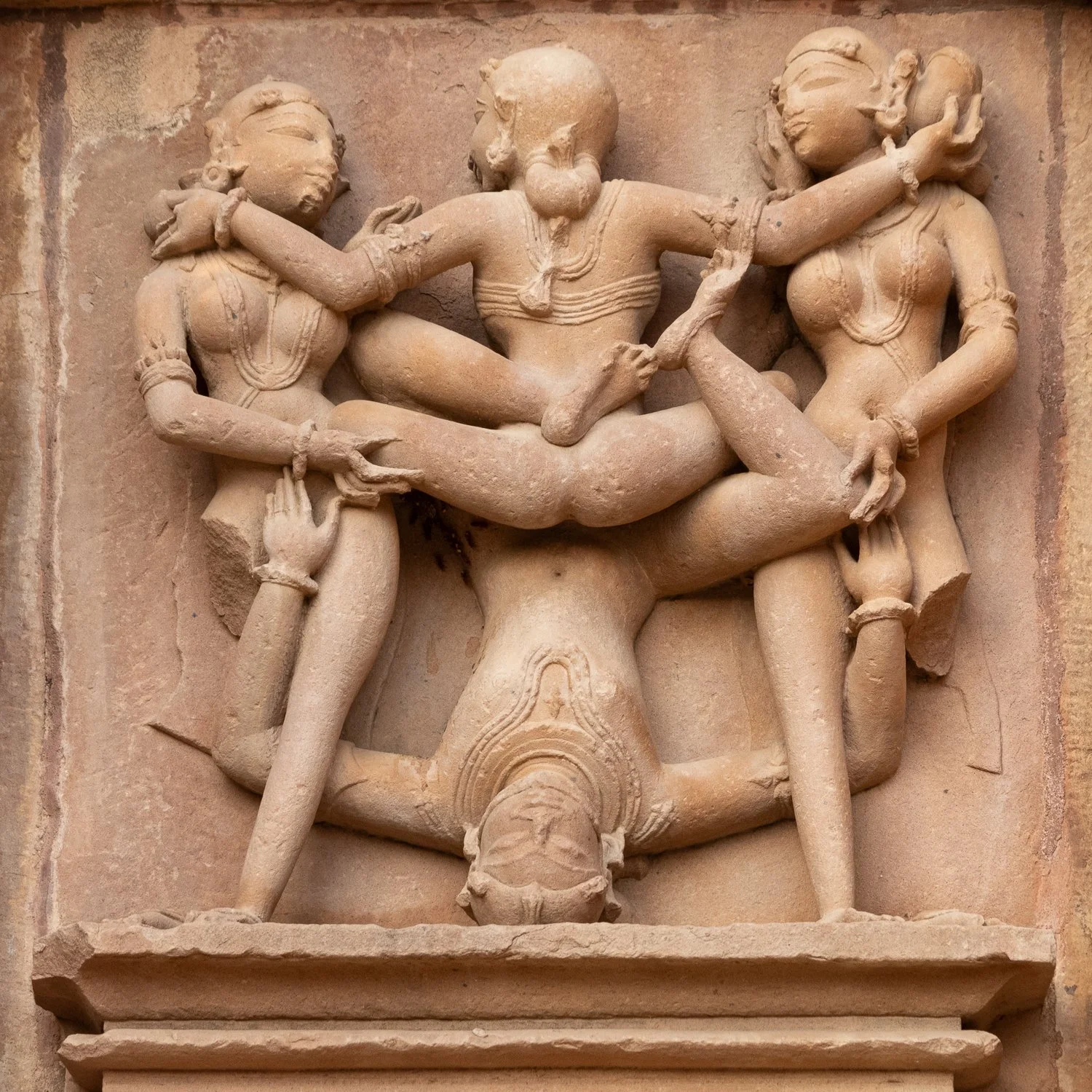
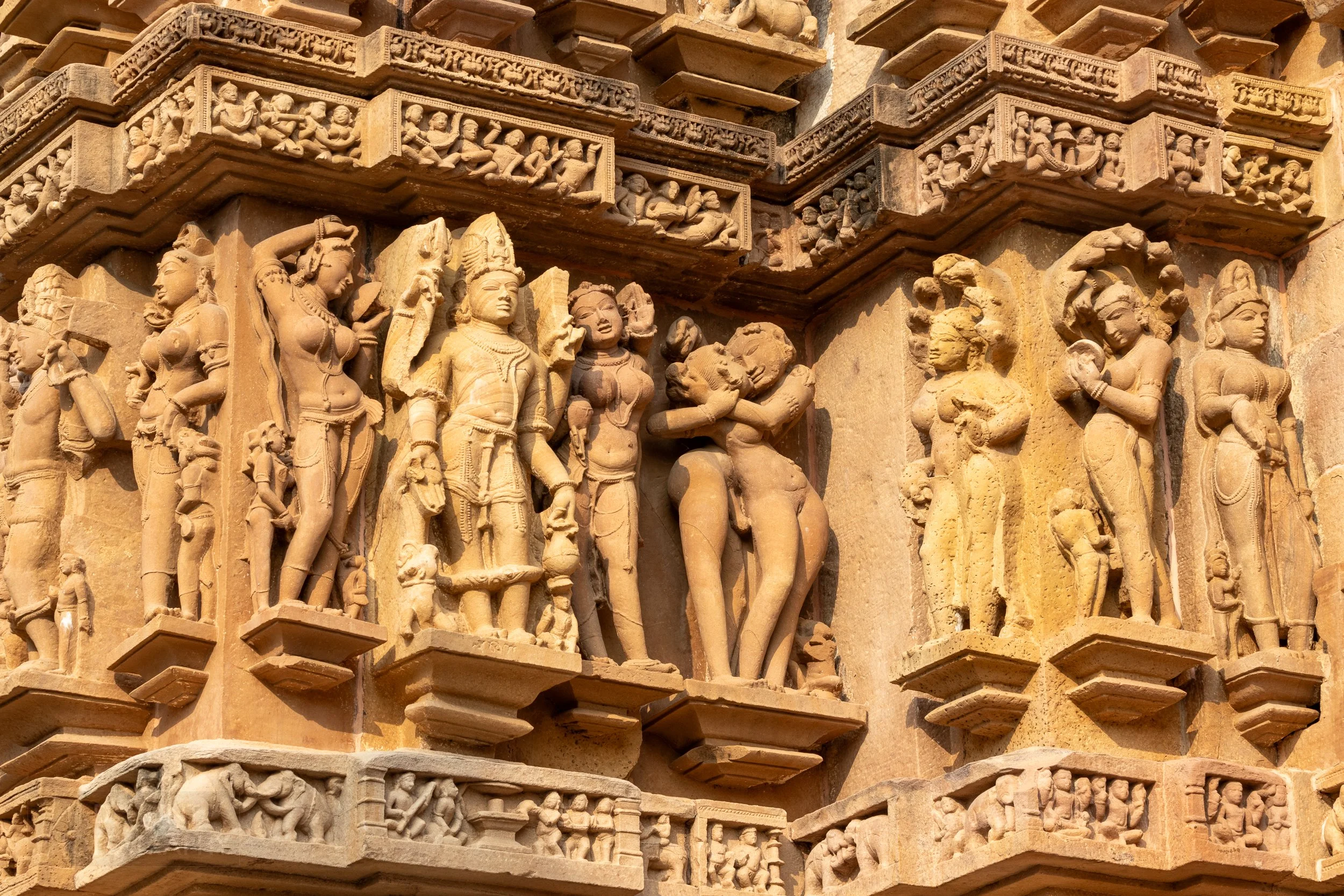
Nearly every exterior surface of the sandstone Lakshmana Temple is covered with a figure; while a legitimate count of the total number of figures is difficult to find, it is estimated that at least 600 Hindu deities are represented.
5. Lakshmana Temple #4
As with many of the Western Group temples, the exterior of Lakshmana Temple features erotic scenes …
6. Lakshmana Temple #5
… This has led to Khajuraho being referred to as the “Kama Sutra Temples” …
7. Lakshmana Temple #6
… Despite only about 10% of the statues depicting erotic acts.
8. Lakshmana Temple #7
Nevertheless, the erotic statues have resulted in Khajuraho’s notoriety and prominence as a tourist attraction.
9. Lakshmana Temple #8
The reason behind the erotic statues is not fully known and is debated …
10. Lakshmana Temple #9
… One theory is that the temples’ statues represent the four Hindu goals of life - Dharma, Artha, Kama, and Moksha, with the statues representing Kama, or desire …
11. Lakshmana Temple #10
… While another theory states that this represents that worshipers were to leave their desires at the outside of the temple; this viewpoint is bolstered by the lack of erotic depictions inside the temple buildings themselves …
12. Lakshmana Temple #11
… One final theory is that the depictions -erotic or otherwise- are intended as a celebration of life …
13. Lakshmana Temple #12
… Whatever the case may be, there is no denying the figures are incredibly intricate and exceptionally well-made.
14. Lakshmana Temple #13
Lakshmana Temple is the oldest temple in the Western Group, commissioned by Yashovarman of the Chandela dynasty, although he passed away prior to its completion.
15. Lakshmana Temple #14
The Lakshmana Temple has six major architectural elements …
16. Lakshmana Temple #15
… An ardha mandapa, or entrance porch, a mandapa, or hallway, a maha mandapa, or great hall, an antarala, or vestibute, and a garba griha, or shrine, which sits inside the sikhara, or tower.
Want to support this ad-free web page?
Considering giving us a follow on Instagram - it's free!
Thanks for your support!
17. Lakshmana Temple #16
Lakshmana Temple sits atop an unusually high platform which creates the illusion that the temple is taller than it is.
18. Vishvanatha Temple #1
Vishvanatha Temple was completed about 60 years after Lakshmana Temple and is dedicated to Shiva.
19. Lakshmana Temple #17
The interior of the Lakshmana Temple is small and cramped; rather than being a place of congregation, it is considered more a home for Vishnu.
20. Lakshmana Temple #18
Along the southern edge of the Lakshmana Temple is a long series of figures depicting what can only be described as a human-animal orgy; it contains what is arguably the most famous figure of the temple.
21. Lakshmana Temple #19
22. Lakshmana Temple #20
23. Lakshmana Temple #21
24. Lakshmana Temple #22
25. Pratapeshwar Temple #1
Pratapeshwar Temple (right) is a relatively modern building, constructed in the 19th century; it was intended as a memorial to its builder.
26. Kandariya Mahadeva #1
Kandariya Mahadeva is the largest of the temples at Khajuraho, and was completed in the mid-11th century.
27. Kandariya Mahadeva #2
Kandariya Mahadeva is the most decorated of the Khajuraho Temples, containing over 800 figures; one total from the time of the complex’s rediscovery in the 19th century was 646 figures on the temple’s exterior and 226 on its interior.
28. Kandariya Mahadeva #3
Kandariya Mahadeva features over 80 spires and is 32 meters / 102 feet tall.
29. Kandariya Mahadeva #4
Similar to many of the other temples at Khajuraho, it features its fair share of erotic sculptures.
30. Kandariya Mahadeva #5
The larger figures on the exterior are up to one meter / three feet tall.
31. Kandariya Mahadeva #6
32. Kandariya Mahadeva #7
33. Kandariya Mahadeva #8
34. Kandariya Mahadeva #9
35. Kandariya Mahadeva #10
36. Kandariya Mahadeva #11
37. Kandariya Mahadeva #12
38. Kandariya Mahadeva #13
39. Kandariya Mahadeva #14
40. Kandariya Mahadeva #15
41. Devi Jagadambi Temple
Devi Jagadambi Temple, just north of Kandariya Mahadeva, dates from the early 11th century and is dedicated to the goddess Parvati; it continues the use of erotic imagery.
42. Kandariya Mahadeva #16
A wide view of Kandariya Mahadeva Temple.
43. Chitragupta Temple
Chitragupta Temple is dedicated to the sun god Surya and was completed in the early 11th century.
44. Khajuraho Sunset
The sun begins to set over Khajuraho.
45. Vishvanatha Temple #2
Close-up view of Vishvanatha Temple.
46. Pratapeshwar Temple #2
Up-close view of Pratapeshwar Temple.
47. Pratapeshwar Temple #3
A view across the Western Grouping of Temples.
48. Parshvanatha #1
On the eastern side of present-day Khajuraho, you will find a grouping of Jain temples; one of these temples is Parshvanatha, likely built to the Jain figure Adinatha.
49. Parshvanatha #2
Despite being a Jain temple, it has many of the exterior architectural figures and flourishes of the Hindu temples of the Western Grouping; this leads historians to believe it was converted from a Hindu temple into a Jain temple.
50. Adinatha Temple #1
Adinatha Temple, completed in the 11th century, is adjacent to Parshvanatha Temple and is built in a similar architectural style.
51. Parshvanatha #3
The entranceway of Parshvanatha Temple contains one of the world’s oldest-known most perfect squares; however, I didn’t want to interrupt this very much naked man’s meditation session to have a look … hopefully you understand….
52. Jain Temple #1
Several traditionally Jainist temples can also be found at the complex.
53. Adinatha Temple #2
Many Jains are present at this temple complex and are happy to make time to speak with visitors.
54. Jain Temple #2
Jains aspire to what is called ascetic life, which among other things involves not owning personal possessions, to include clothing. Jains are often strictly vegan, going so far as to avoid consuming root vegetables, as their removal from the earth may be harmful to insects.
55. Parshvanatha #4
One last view of Parshvanatha Temple.
Following our visit to Parshvanatha Temple, our guide gave us the option of attending a religious ceremony at the Matangeshvara Temple, which we were keen to agree to. This ceremony would happen around sunset, which gave us plenty of time to explore the nearby stone carving shop (I was super, super, super pleased how seldomly our local tour guides pushed local shops on us!) Then, it was off to the temple.
56. Matangeshvara Temple #1
Of all the temples in Khajuraho, Matangeshvara Temple is the only one currently used for worship.
This was a very traditional arti ceremony (in contrast to the tourist-oriented show we’d see in Varanasi in a few days), and I was very happy we had at least one authentic cultural experience with locals during our travels. I really enjoyed our time in India, but our guides (with, no doubt, very good reason) definitely went to great lengths to make sure our trip wasn’t too authentic: we could only eat at certain “approved” restaurants, use only certain “approved” toilet blocks, and not engage directly with any locals.
57. Matangeshvara Temple #2
Matangeshvara Temple dates from the early 11th century and features a 2.5 meter / 8 foot lingam, a cylindrical representation of Shiva.
58. Matangeshvara Temple #3
Unlike the other temples at Khajuraho, Matangeshvara Temple is plainly decorated.
For now, the time had come to call it an evening and the three of us were wiped out from the very long day out.
The following day was pretty straightforward: we’d make our way by van to the Jhansi train station, then board a train for Agra where we’d be met by our local guide team there. The train was surprisingly comfortable and the journey was generally uneventful; however, it didn’t undue my firmly rooted belief that an overnight train was not the best of ideas as passengers were seemingly free to move from one carriage to another.
We arrived in Agra and made our seamless transition to our hotel, the Howard Plaza The Fern. After destroying an impossibly large meal at the on-site Chinese food restaurant (none of us had really eaten since breakfast), we headed to bed knowing we’d have another early day in the morning visiting the one-and-only Taj Mahal.