Agra
Day Seven - India - 2024
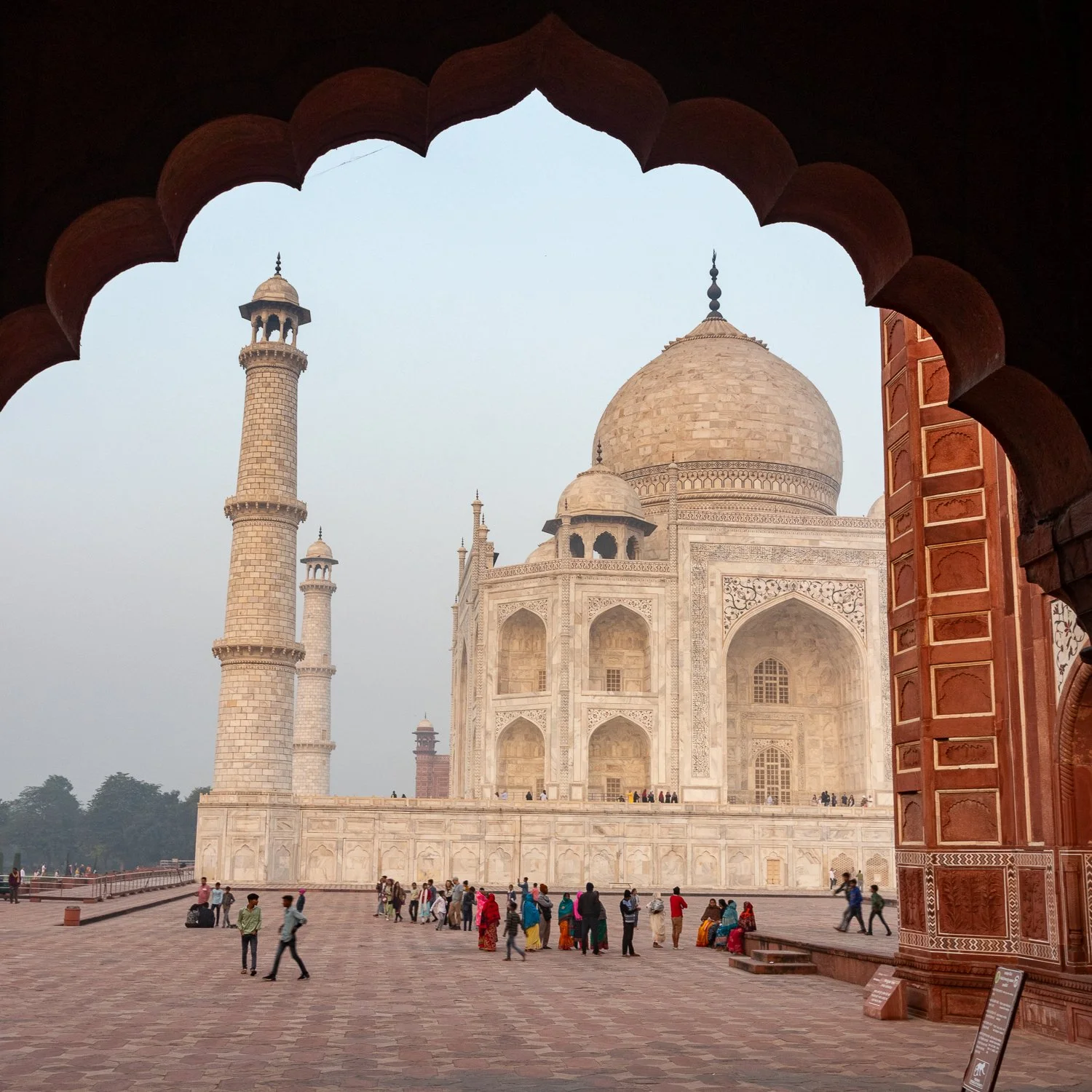
A full day exploring the best sites of Agra, including Agra Fort, the Tomb of I’timad-ud-Daulah, and -of course- the Taj Mahal.
1. Taj Mahal #1
On normal operating days, the Taj Mahal opens 30 minutes before sunrise and closes 30 minutes before sunset.
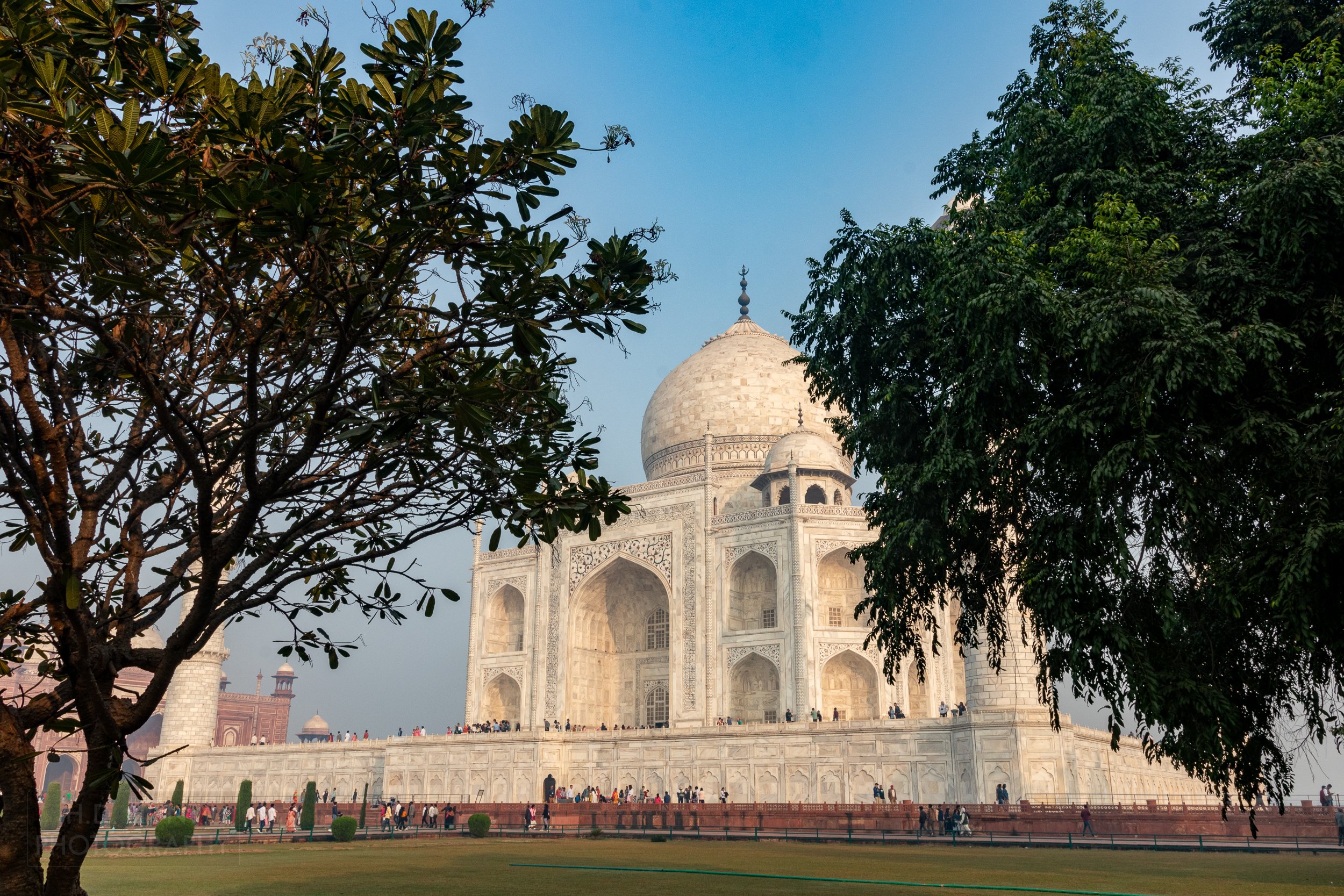
Another day, another early morning wake-up. But this time it was to visit India’s crown jewel, the Taj Mahal, and I don’t think any of us were going to complain about that!
In my Petra travelogue, I contend that the Taj Mahal is one of the world’s three greatest tourist destinations, along with Petra itself and Machu Picchu. I’ll spare you all the details how I came to that conclusion, but suffice it to say only these three locations satisfy all of the following criteria:
High historical and cultural value,
Significant total visitation,
Remoteness from other prominent tourist sites,
Seen as a cultural or national symbol, and,
Is majestic or beautiful.
Having also been to Machu Picchu, the Taj Mahal was the last of this Triple Crown of Tourism for me to visit and I was very, very excited to finally be able to see it first-hand!
2. Taj Mahal #2
The magnificent Main Gateway to the Taj Mahal -sometimes called the Northern Gate, Royal Gate, or Mausoleum Gate- was constructed of red sandstone between 1632 and 1638.
We were able to make our way into the complex right before sunrise, and I incredibly thankful the morning smoke was minimal. In fact, the smoke was so bad in Agra just the day prior you couldn’t see the Taj Mahal at all.
In total, we spent two hours walking around the complex and inside the mausoleum. 25 additional photographs from our visit follow.
3. Taj Mahal #3
The Royal Gate is adorned with Arabic calligraphy as well as Hindu artistic motifs.
4. Taj Mahal #4
The Royal Gate is designed to create the optical illusion that causes the size of the Taj Mahal to shrink as you move towards it.
5. Taj Mahal #5
The Taj Mahal was constructed between 1631 and 1653, involving the efforts of over 20,000 craftsmen and laborers.
6. Taj Mahal #6
The Taj Mahal was commissioned by the fifth Mughal Emperor, Shah Jahan.
7. Taj Mahal #7
The four towers of the Taj Mahal are designed to fall away from the building’s central dome in the event of a natural disaster.
8. Taj Mahal #8
The Main Gate features four corner main cupolas, and two sets of eleven central cupolas.
9. Taj Mahal #9
While it is well-known that the Taj Mahal is a mausoleum, what is less known is that the tombs inside are actually just cenotaphs for Shah Jahan and his wife, Mumtaz Mahal; they are both in reality buried underneath the building, in keeping with Islamic tradition.
10. Taj Mahal #10
Despite being made primarily of white marble, the color of the building appears to change depending on the time of day and the angle of the sun, sometimes appearing yellow, brown, or even pink.
11. Taj Mahal #11
Taj Mahal literally means, “Crown of the Palace.”
12. Taj Mahal #12
The building’s designer, Ustad Ahmad Lahori -also known as Ahmad the Architect- also designed Delhi’s Red Fort.
13. Taj Mahal #13
The Taj Mahal sits atop a 6 meter / 20 foot tall plinth.
14. Taj Mahal #14
The weight of the Taj Mahal is greatly debated, with estimates ranging between 58,000 and 100,000 tons (the latter the equivalent of an aircraft carrier); the dome alone is believed to weigh 12,500 tons.
15. Taj Mahal #15
The Taj Mahal is eight-sided - the large square-shaped base has slightly chamfered corners.
16. Taj Mahal #16
The exterior of the building features multiple jalis, stone resembling a latticed screen.
17. Taj Mahal #17
The four minarets of the Taj Mahal are 40 meters / 130 feet tall.
18. Taj Mahal #18
When it was designated a UNESCO World Heritage Site in 1983, it was declared that the Taj Mahal was “one of the universally admired masterpieces of the world's heritage.” Facts.
19. Taj Mahal #19
The interior of the mausoleum features a 25 meter / 82 foot tall false domed ceiling …
20. Taj Mahal #20
… while the central dome itself measures 73 meters / 240 feet tall at its pinnacle.
21. Taj Mahal #21
The Taj Mahal’s mosque was built to satisfy Islamic law; to maintain the site’s symmetry, it is paired with the identical mehmaan khana, or drawing room, on the other side of the mausoleum.
22. Taj Mahal #22
The Arabic calligraphy on the building’s exterior is made of jade and black marble, and is cleverly larger the higher up the building it is to maintain its aspect.
23. Taj Mahal #23
The building features multiple flat-sided columns inlaid with patterns which create a very convincing optical illusion of depth.
24. Taj Mahal #24
The Taj Mahal sits on a 17 hectare / 42 acre complex.
25. Taj Mahal #25
A central reflecting pond runs from the Main Gate to the base of the mausoleum, a distance of 272 meters / 895 feet.
26. Taj Mahal #26
The building is made predominantly of Makrana marble, named after the town of the same name; astonishingly, this town is 320 kilometers / 200 miles away, meaning every piece used on the site had to be hauled this distance.
So how can I summarize my experience at the Taj Mahal? Well, to do that I need to talk about expectation management. I consider myself fairly well-traveled and countless times I’ve heard people build up destinations, cities, and events to the point that there is absolutely no way experiencing it can ever live up to the hype they’ve created. To be clear, I’m very much guilty of this: I certainly oversell how amazing seeing a total eclipse is, for example, because the event is incredibly impactful to me. I think it is human nature to want to do this.
Now, how does this concern the Taj Mahal? I couldn’t fathom how so many people -visitors, architects, and historians alike- were completely hyping up just how astonishing this place was. Few places achieve universal acclaim, and certainly the Taj Mahal is one of those rare cases. How, just how, could something ever live up to that? The cynical part of me just screams out, “it’s just a mausoleum.”
But, having visited it: I get it. I totally get it. The building is astonishing in terms of both beauty and engineering. The amount of passion and willpower that went into constructing this building defies all comprehension. Every minuscule detail was thought out. It is, simply, a masterpiece of human achievement, perhaps even our greatest singular work.
Somehow, some way: visiting the Taj Mahal exceeded my expectations.
27. Taj Mahal #27
The Jilaukhana (Forecourt) of the Taj Mahal is the first example of its kind in Mughal architecture.
Want to see more of the real world?
Then follow us on Instagram!
Thanks for your support!
28. Agra Fort #1
Between 1565 and 1573, the ruins of a fort called Bandalgarh were renovated by Akbar, the third Mughal Emperor and transformed into the red sandstone Agra Fort.
Following our incredible visit to the Taj Mahal, we made our second stop of the day, Agra Fort. We spent a little over an hour wandering this complex with our guide, and fourteen photographs from our visit follow.
29. Agra Fort #2
During its construction, it is believed about 4,000 workers labored each day over the eight year period.
30. Agra Fort #3
Agra Fort may have once contained 500 buildings; presently, only about 30 currently exist.
31. Agra Fort #4
The fort served as the seat of the Mughal Dynasty until the capital was moved to Delhi in 1638.
32. Agra Fort #5
The fort sits on 38 hectares / 94 acres.
33. Agra Fort #6
Control of Agra Fort changed hands multiple times after the Mughal Empire’s capital moved to Delhi …
34. Agra Fort #7
… It fell under control of the British East India Company following the Second Anglo - Maratha War in 1803 …
35. Agra Fort #8
… Following the defeat of the British East India Company in the Indian Rebellion of 1857-58, the fort became the property of the British Raj …
36. Agra Fort #9
… It was during this period of British control that many of the fort’s buildings were destroyed to make way for military barracks and other buildings.
37. Agra Fort #10
Shah Jahan was imprisoned at Agra Fort by his son, Aurangzeb, following an illness …
38. Agra Fort #11
… Aurangzeb, who already declared himself the sixth Mughal Emperor following a brief civil war, didn't wish his father to recover and reclaim leadership …
39. Agra Fort #12
… Shah Jahan spent eight years at the Fort under the care of his daughter …
40. Agra Fort #13
… The Taj Mahal was completed by this time, and Shah Jahan could see its glory from the highest ramparts of the fort …
41. Agra Fort #14
… Upon his death, Shah Jahan’s body was transferred to the Taj Mahal by boat, where it currently rests.
42. Agra Fort #15
The Lahore Gate -alternatively the Amar Singh Gate- was reserved for Emperor Akbar’s use; a second gate, the Delhi Gate, was intended for public use, but today that gate enters a section controlled by the Indian military and is not open to the public.
Following our visit, we did some quick shop trips and returned to our hotel for a mid-day siesta.
43. Tomb of I’timad-ud-Daulah #1
The Tomb of I’timad-ud-Daulah -commonly referred to as “The Baby Taj” or “The Jewel Box”- was constructed between 1622 and 1628 as a mausoleum for Mirza Ghiyas Beg, known also as I’timad-ud-Daulah.
Heading back out into the city, we made a quick stop at the so-called “Baby Taj.” While this small mausoleum pales in comparison to its more famous neighbor, it is certainly a lovely building and worthy of a visit if you are in Agra. Twelve more photographs of the Tomb of I’timad-ud-Daulah follow.
44. Tomb of I’timad-ud-Daulah #2
It was the first Mughal monumental building built of white marble vice red sandstone.
45. Tomb of I’timad-ud-Daulah #3
Interestingly, I’timad-ud-Daulah was the grandfather of Mumtaz Mahal, for whom the Taj Mahal was built in remembrance.
46. Tomb of I’timad-ud-Daulah #4
While many of the interior art looks as if it is a painted image, in reality they are made of incredibly thin delicate stones; this is known as pietra dura.
47. Tomb of I’timad-ud-Daulah #5
The interior of the building lets in natural light by its multiple jali screens.
48. Tomb of I’timad-ud-Daulah #6
While nearly identical, the cenotaphs within the Tomb of I’timad-ud-Daulah (including that of his wife, Asmat Begum) are the only non-symmetrical elements within the building.
49. Tomb of I’timad-ud-Daulah #7
50. Tomb of I’timad-ud-Daulah #8
51. Tomb of I’timad-ud-Daulah #9
52. Tomb of I’timad-ud-Daulah #10
53. Tomb of I’timad-ud-Daulah #11
64 panels on the building’s exterior recite Koranic verse.
54. Tomb of I’timad-ud-Daulah #12
The building’s minarets are 13 meters / 43 feet tall.
55. Tomb of I’timad-ud-Daulah #13
Nur Jahan -the building’s patron, Mughal Empress, daughter of I’timad-ud-Daulah, and mother-in-law of Shah Jahan- infused Persian elements into the building, evoking her own family’s heritage.
56. Taj Mahal Yamuna View Point #1
While Mehtab Bagh -the garden across the Yamuna River from the Taj Mahal- is primarily used for sunset photographs of the building …
Following our visit to the Baby Taj, we made our way to the Taj Mahal viewing location just across the Yamuna River for sunset. Again, I want to stress that I was incredibly delighted the smoke and smog were very minimal, and this allowed us to thoroughly enjoy the sun setting against one of the world’s most beautiful buildings.
Four more sunset photographs follow.
57. Taj Mahal Yamuna View Point #2
… It is rumored the site was intended for a black marble version of the Taj Mahal …
58. Taj Mahal Yamuna View Point #3
… That Shah Jahan would use as his burial site upon his death …
59. Taj Mahal Yamuna View Point #4
… There is no positive evidence indicating this was Shah Jahan’s intent; however …
60. Taj Mahal Yamuna View Point #5
… Some minor excavation activities undertaken at the time of the Taj Mahal’s construction continually fuels speculation.
Following this, we returned again to our hotel where we enjoyed a lovely pizza dinner (I love, love, love Indian food, but even I get tired of it…) before calling it an evening.