Varanasi
Day Eleven - India - 2024
A sunrise-to-sunset tour of the ancient city of Varanasi, including a boat ride on the Ganges and the famous Arti Ceremony.
1. Ganges River Boat Tour #1
Varanasi (also known as Banaras, Benares, and Kashi) is a Hindu pilgrimage city on the Ganges River.
Very early the next morning, we made our way down to the Ganges River for a morning boat tour. This is a very standard offering in Varanasi, and certainly one that is not to be missed. Two bits of advice: don’t feed the birds, and by absolutely no means should you touch the water!
Eighteen photographs from our morning boat tour follow.
2. Ganges River Boat Tour #2
Varanasi is known for its 84 ghats, sets of steps which lead down to the river.
3. Ganges River Boat Tour #3
Of the 84 ghats, 82 are used for bathing and ceremonial worship, while two are used for cremation.
4. Ganges River Boat Tour #4
The only way to see these ghats is by taking a tour boat along the Ganges River.
5. Ganges River Boat Tour #5
Many of the ghats were renovated into their present form in the 18th century.
6. Ganges River Boat Tour #6
Bathing in the Ganges River is believed by Hindus to cleanse one of sins.
7. Ganges River Boat Tour #7
It is estimated that over 100,000 visitors come to Varanasi daily for bathing and other religious ceremonies.
8. Ganges River Boat Tour #8
Worshipers often place floating candles in honor of Ganga, the river goddess.
9. Ganges River Boat Tour #9
Dying in Kashi is believed to release one from the cycle of reincarnation; as such, many elderly and ill Hindus come to Varanasi to pass away.
10. Ganges River Boat Tour #10
The bodies of those recently passed are often cremated in a funeral pyre in the city, with their ashes placed into the river in a ceremony.
11. Ganges River Boat Tour #11
Its overall importance means Varanasi is the holiest of the Santa Puri, or holiest cities of Hinduism.
12. Ganges River Boat Tour #12
Hindu and non-Hindu visitors are welcome to place a burning candle into the river.
13. Ganges River Boat Tour #13
14. Ganges River Boat Tour #14
Each of the ghats are easily identifiable from the river.
15. Ganges River Boat Tour #15
16. Ganges River Boat Tour #16
(Like I said: don’t feed the birds….)
17. Ganges River Boat Tour #17
18. Ganges River Boat Tour #18
19. Ganges River Boat Tour #19
The Ratneshwar Mahadev Mandir temple has a dramatic 9-degree lean (for reference, the Tower of Pisa leans at 4 degrees.)
We run this website for free - show your support with a follow on Instagram!
Thanks for your support!
20. Varanasi #1
In addition to its 84 ghats, Varanasi is estimated to be home to 23,000 (!) religious temples.
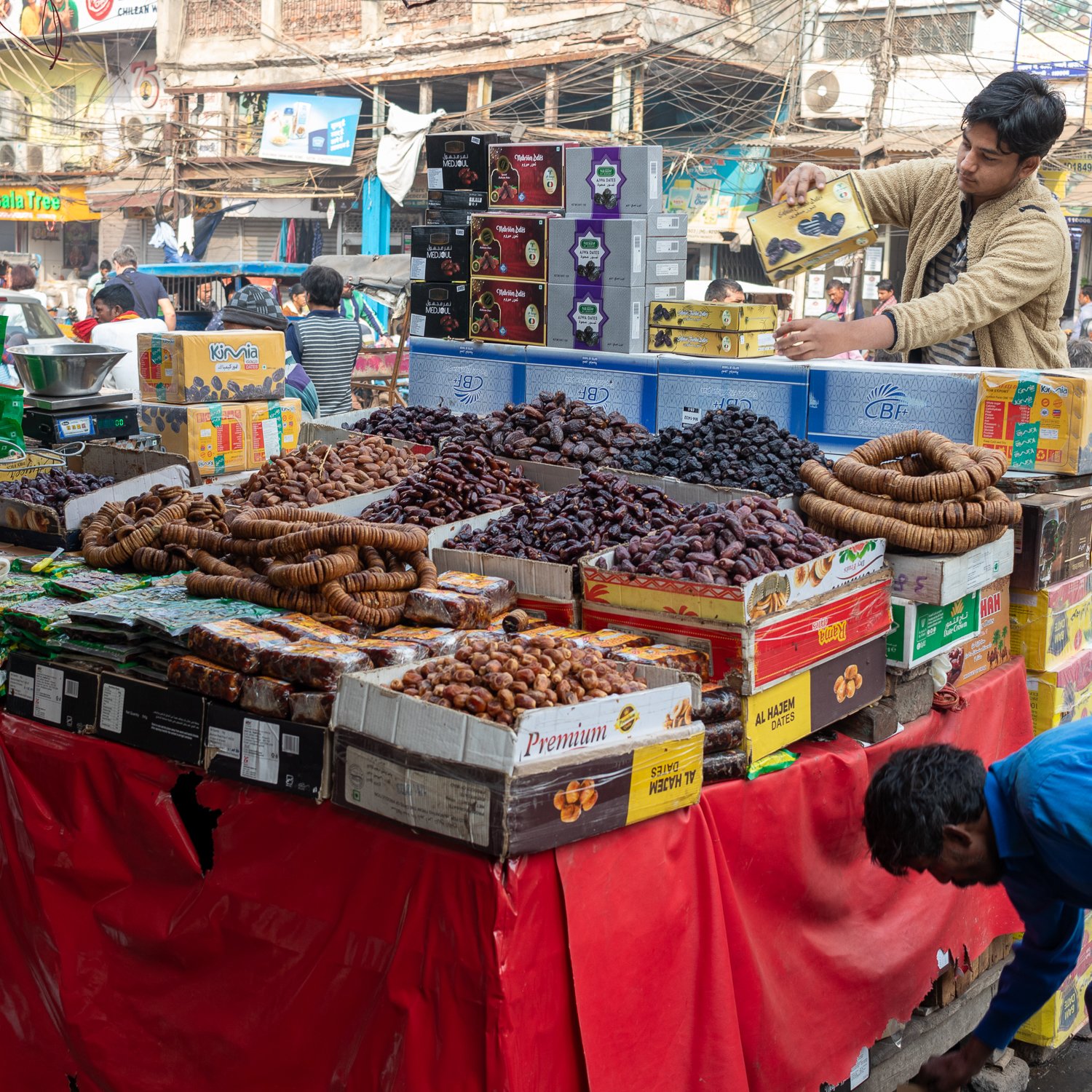
Back on land, we undertook a short walking tour of the city center. Put simply: Varanasi is a madhouse of activity! There are wall-to-wall visitors and locals crammed into tiny alleyways surrounded on both sides by small temples, storefronts, apartment blocks, and hospice care centers, and in between them come weaving motorbikes, delivery carts, and workers carrying impossibly large parcels and building materials. There isn’t a moment’s rest in this town, and I can’t recall seeing anything like it in my entire life. Thankfully, our guide was able to safely navigate us through the chaos, but -low-key- I was relieved to get out of there.
Six photographs from the city center follow.
21. Varanasi #2
22. Varanasi #3
23. Varanasi #4
24. Varanasi #5
25. Varanasi #6
26. Varanasi #7
27. Mulagandha Kuti Vihara #1
Opened in 1931, Mulagandha Kuti Vihara is a Buddhist temple in Sarnath which houses several relics associated with Gautama Buddha.
After breakfast, we made our way by van north of Varanasi’s city center towards the village of Sarnath, one of the most important sites in Buddhism. Here, we did a walking tour of some historical sites and stopped into the history museum which I didn’t realize housed two of the country’s most prominent archaeological objects (well, by prominent I mean I previously knew they existed.)
Thirteen photographs from our visit to Sarnath follow.
28. Mulagandha Kuti Vihara #2
Frescoes depicting key events in Buddha’s life are painted on the walls of Mulagandha Kuti Vihara.
29. Mulagandha Kuti Vihara #3
Mulagandha Kuti Vihara was completed primarily with private donations.
30. Mulagandha Kuti Vihara #4
Besides Mulagandha Kuti Vihara is a garden with prayer wheels and …
31. Mulagandha Kuti Vihara #5
… A depiction of Buddha’s first sermon, which took place nearby.
32. A Modern-Age Miracle
In 2000, only about 14% of Indians had access to basic plumbing or sanitation; by 2022, this figure jumped to about 78%.
33. Sarnath #1
In 528 BCE, Gautama Buddha chose Sarnath as the site of his first sermon after achieving enlightenment.
34. Sarnath #2
The 43 meter / 141 foot tall Dhamek Stupa marks the location of Buddha’s first sermon; considering this tower was constructed in the 6th century, it is considered an incredible engineering achievement.
35. Sarnath #3
While time has worn many of the stoneworks down, the Dhamek Stupa’s exterior is still adorned with images of flowers and geometric figures.
36. Sarnath Museum #1
The Mauryan leader Ashoka constructed a pillar at Sarnath in 250 BCE following his conversion to Buddhism; atop the pillar stood a lion capital from which two features -the wheel and the lions- were used in imagery for both the flag of the Dominion of India and the state emblem, respectively.
37. Sarnath Museum #2
Buddha Preaching his First Sermon is a statue from the 5th century showing Gautama Buddha in a teaching pose; it is considered the preeminent depiction of Buddha.
38. Sarnath Museum #3
Sarnath Museum contains some 6,800 sculptures …
39. Sarnath Museum #4
… And is the oldest museum of the Archaeological Survey of India.
40. Giant Buddha Statue
In Sarnath, there is a 25 meter / 82 foot tall statue of Buddha, believed to be the largest statue of Buddha in India.
41. Arti Ceremony #1
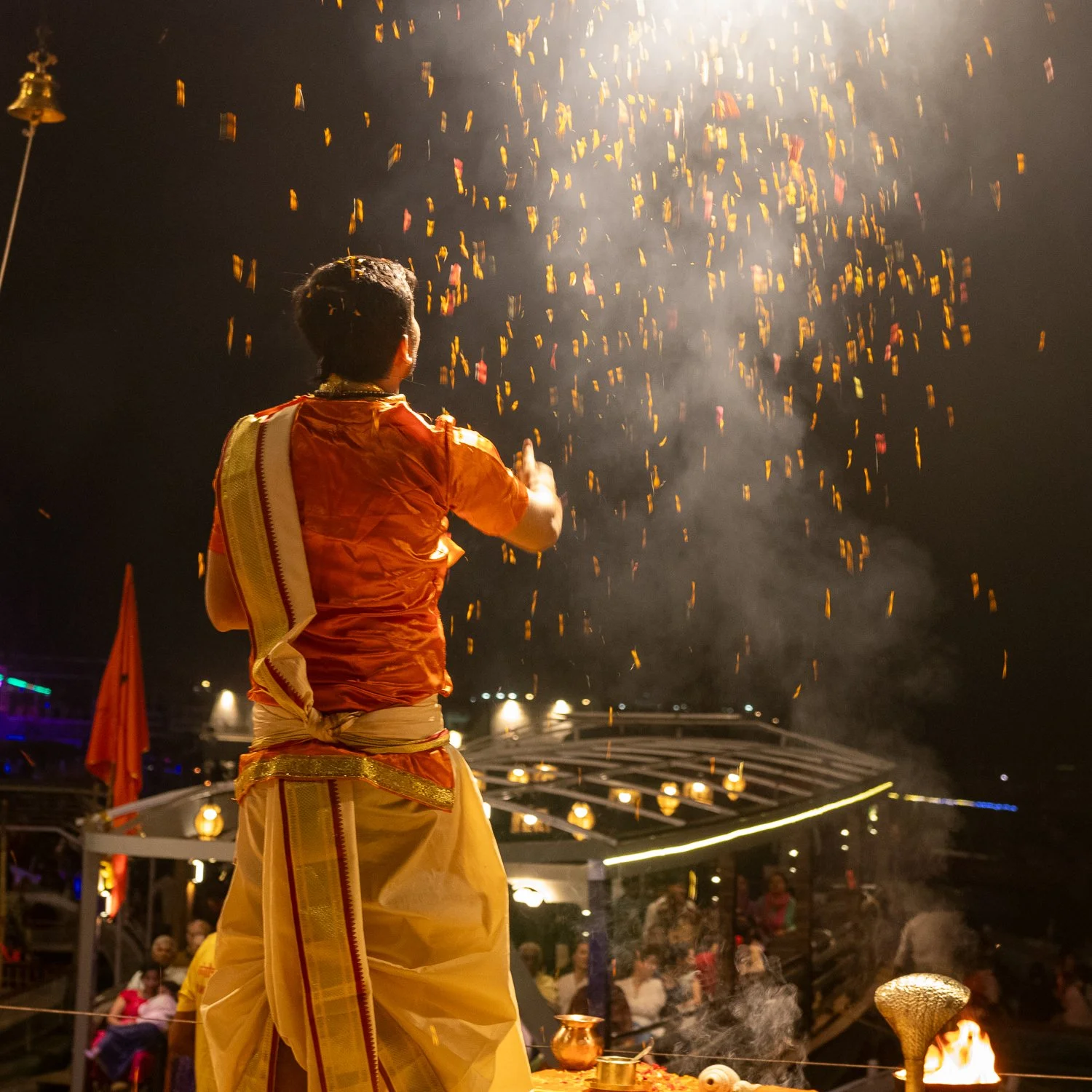
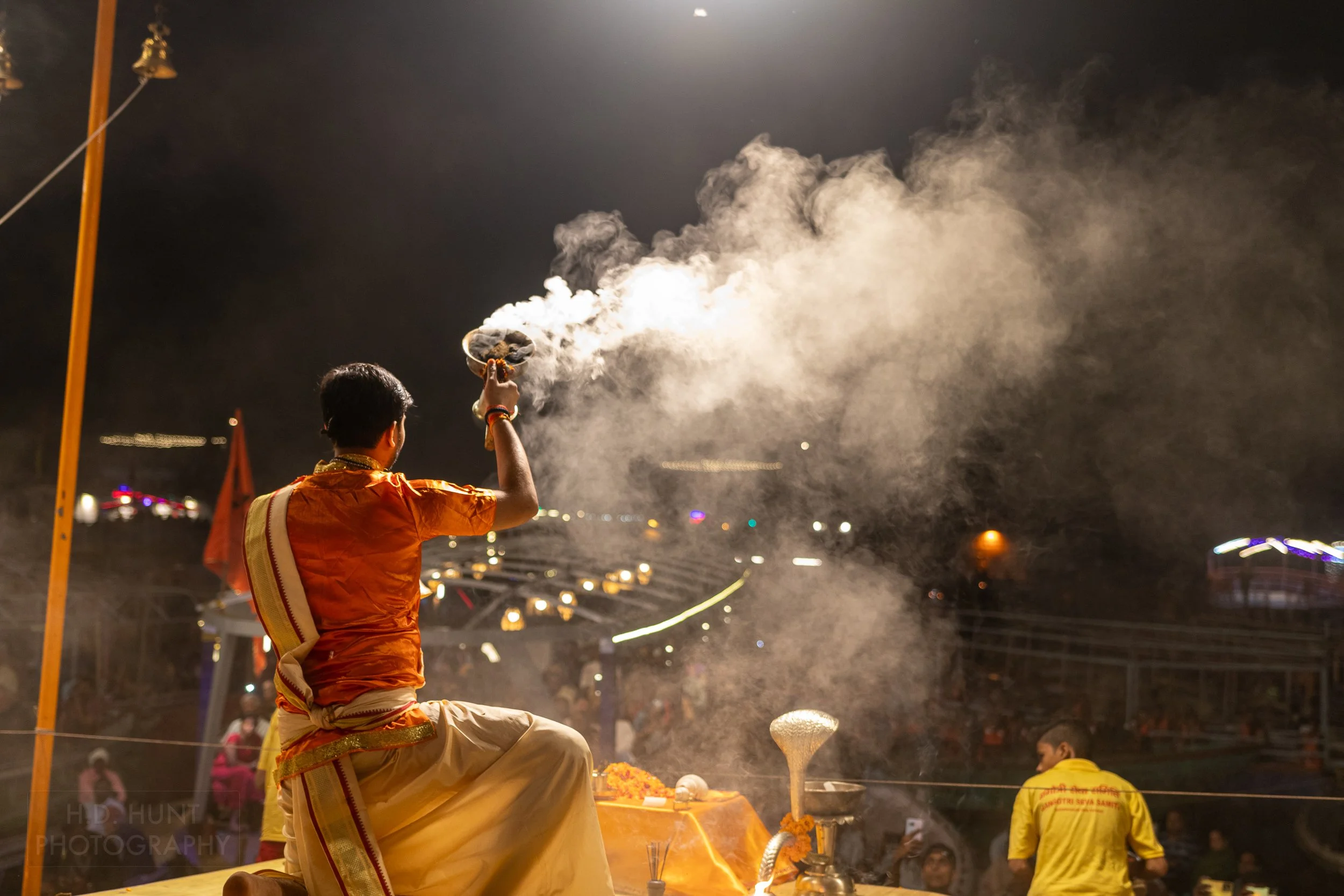
An arti ceremony is a Hindu ritual in which a flame is waived to venerate deities which is often accompanied by singing; the evening arti ceremony in Varanasi is a significant attraction within the city.
We had one last order of business to attend to in Varanasi: the world-famous nighttime arti ceremony along the Ganges River. There are four types of seating for this event: the first is atop the gigantic stone steps of the surrounding ghat, second is on one of the river boats behind the ceremony, third is on the carpeted floor directly in front of and besides the ceremony, and fourth is atop little wooden platforms nearby to the ceremony; our tour guide managed to secure (read: pay) for us the latter option, and we sat with arguably the best view of the proceedings. Obviously geared for tourists (foreign and domestic alike), the arti ceremony is all the same a quite entertaining spectacle of fire, smoke, and light. I don’t normally go in for tourist-oriented shows like this, but I cannot recommend attending this enough if you happen to find yourself in Varanasi one day.
Sixteen additional photographs from the arti ceremony follow.
42. Arti Ceremony #2
Each night, the arti ceremony is performed at the Dashashwamedh Ghat, the largest ghat in Varanasi.
43. Arti Ceremony #3
44. Arti Ceremony #4
45. Arti Ceremony #5
46. Arti Ceremony #6
47. Arti Ceremony #7
48. Arti Ceremony #8
49. Arti Ceremony #9
50. Arti Ceremony #10
51. Arti Ceremony #11
52. Arti Ceremony #12
53. Arti Ceremony #13
54. Arti Ceremony #14
55. Arti Ceremony #15
56. Arti Ceremony #16
57. Arti Ceremony #17
With that complete, we made our way back to the Meraden Grand for one last night in Varanasi. The following day would be another travel day, this time making our way back to Delhi by air before checking in again to our first hotel, the ITC Dwarka. We had a farewell dinner of sorts at a restaurant in the Embassy district of the city before turning in for the evening. While we’d be departing India the following evening, we still had one more day of exploring left!