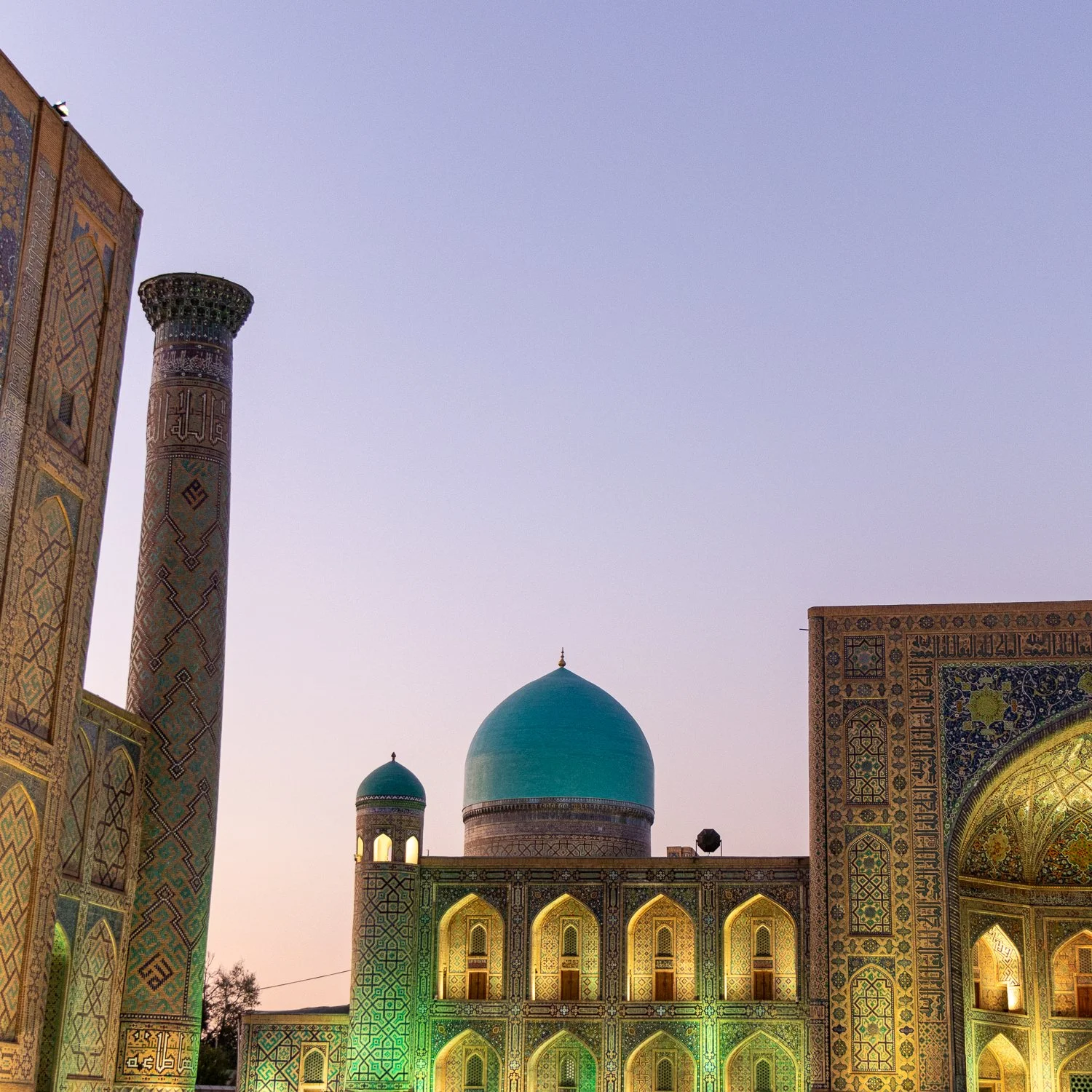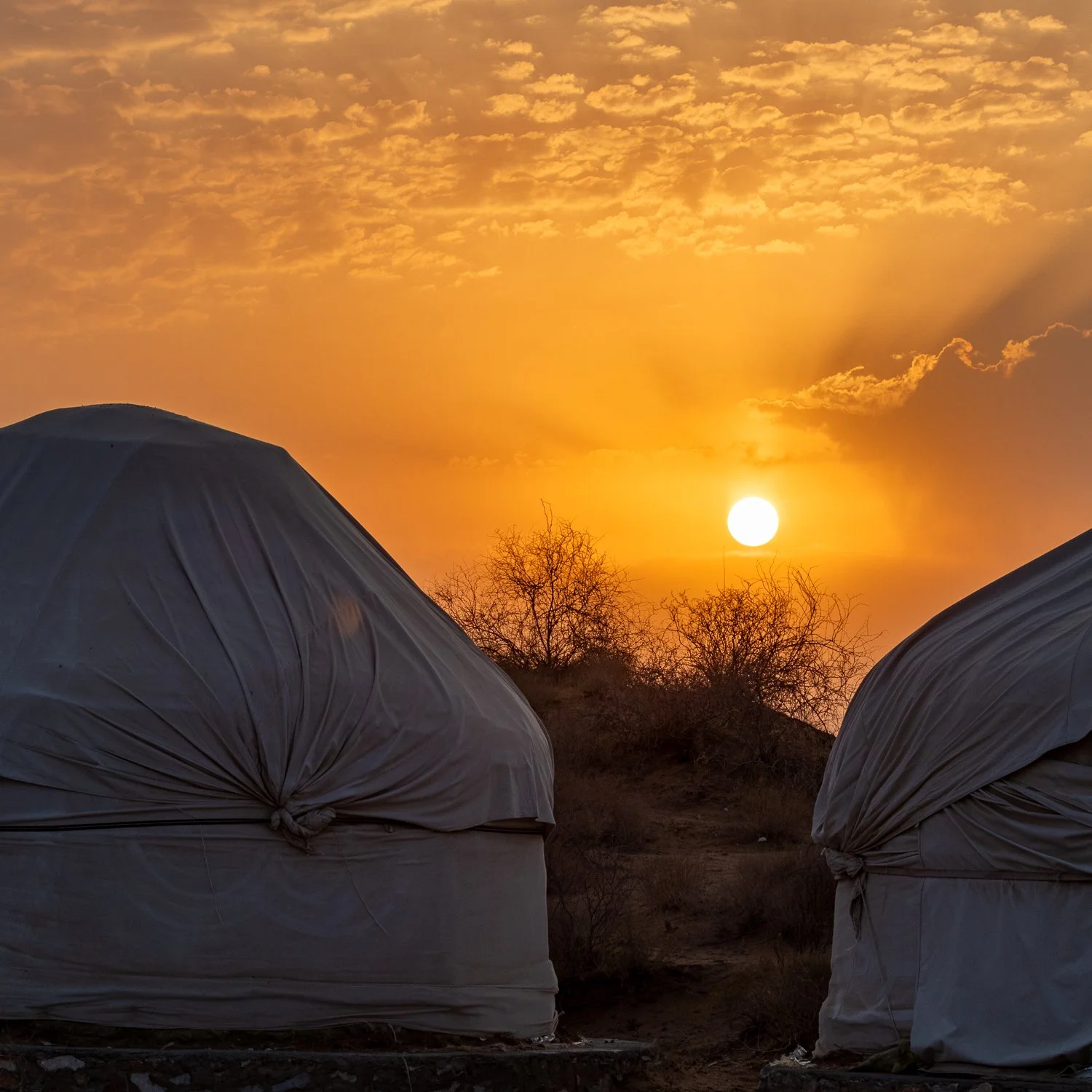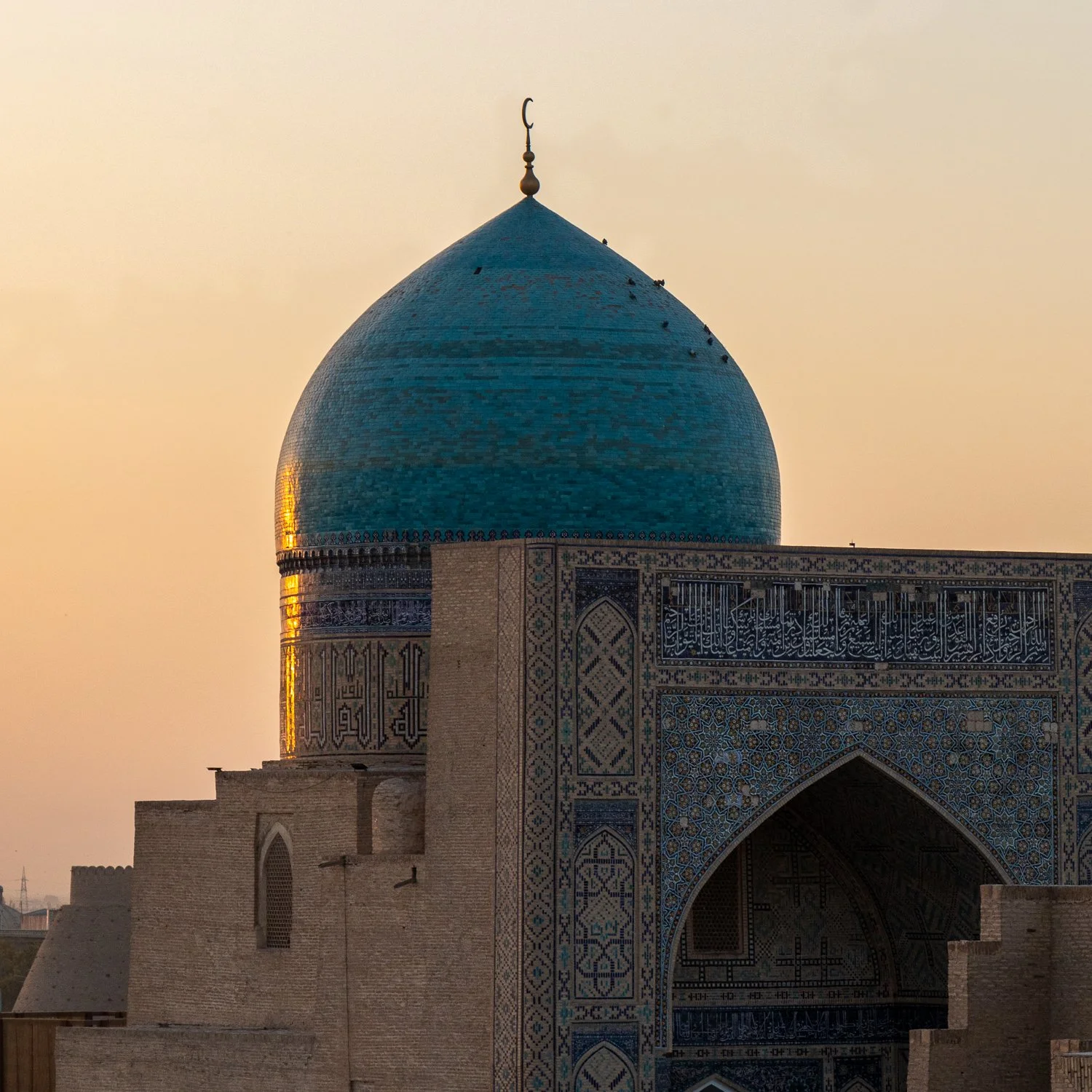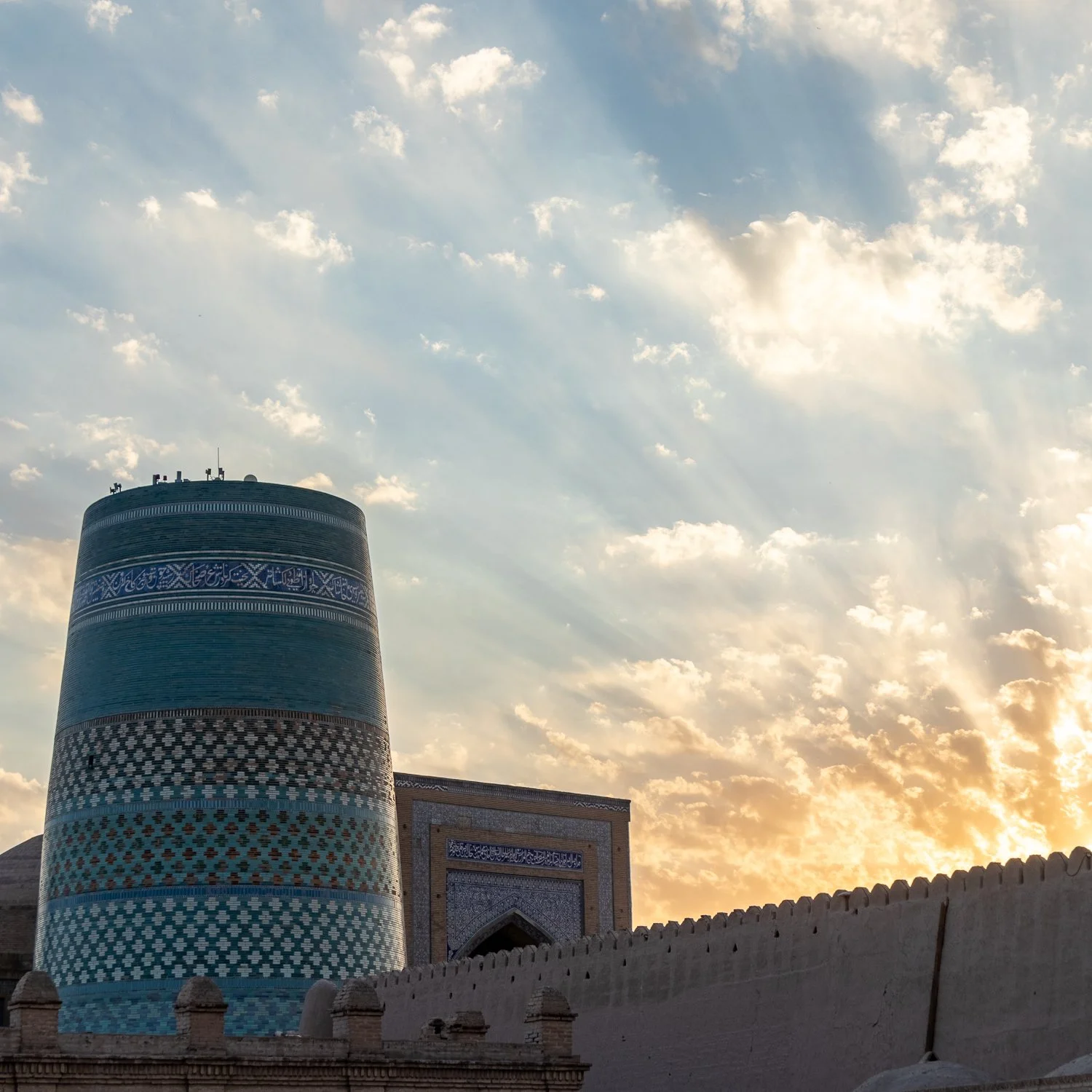
Samarkand
Days One, Two, & Three - Uzbekistan & Oman - 2025
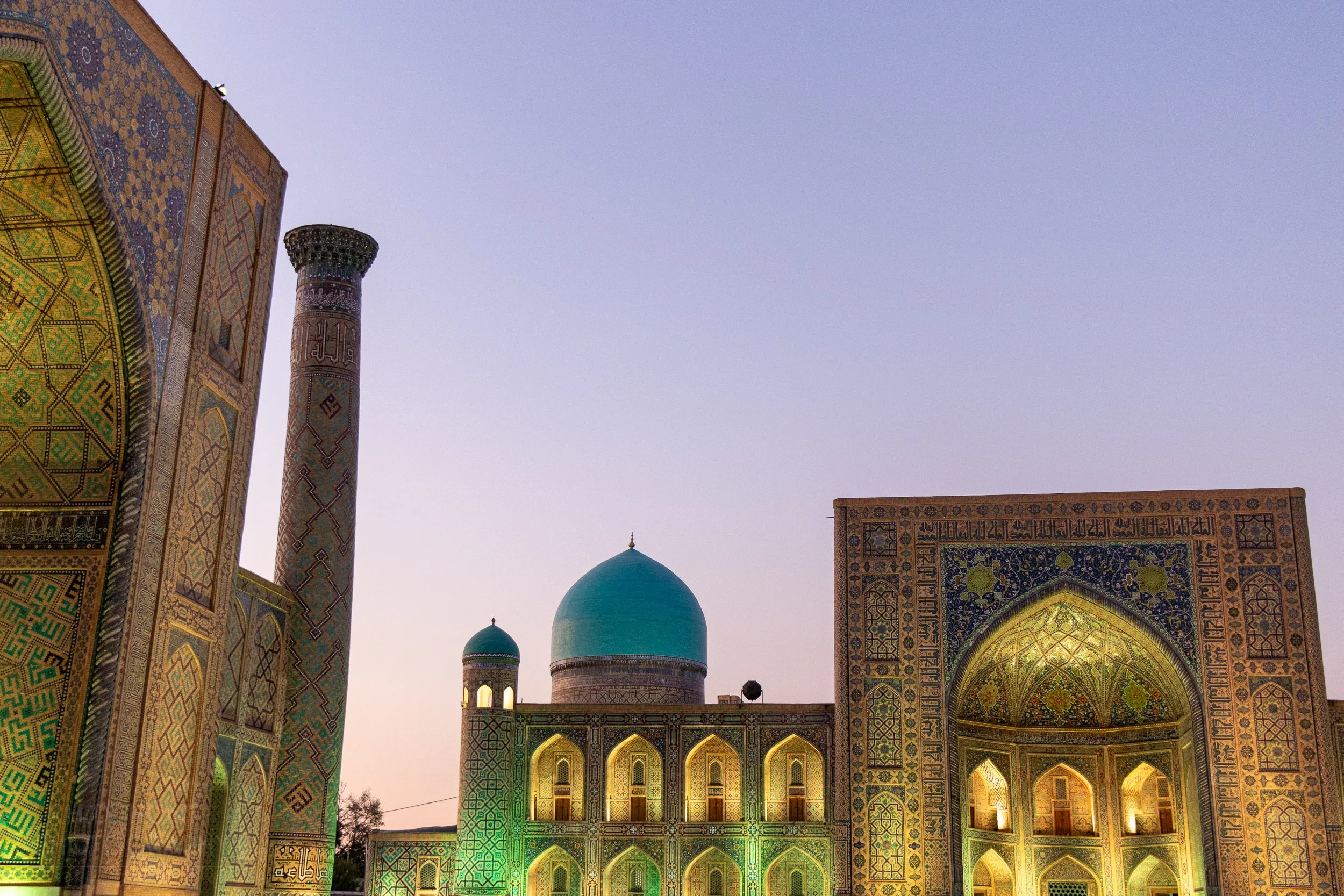
A couple days exploring one of the most architecturally impressive and historically significant cities on earth, Samarkand.
1. Afrosiyob High Speed Train
As of 2025, Uzbekistan has the world’s 13th longest high-speed rail network and the 17th highest top speed, besting the United States in both categories.
To say that reaching Samarkand was an adventure in and of itself is certainly an understatement. In what is increasingly becoming my style for no reason whatsoever, I may have cut my flights a bit too close. After all, arriving about 30 minutes before your tour group welcome meeting after a 13-hour flight from the United States to Dubai and a 3.5 hour connecting flight to Tashkent is rather bold, wouldn’t you say? All’s well that ends well, and I was able to meet up with … well, some … of my travel companions.
See, the tour I took -G Adventure’s Highlights of Uzbekistan- is the middle leg of an up to 26-day gauntlet through Central Asia offered by the company, and while it was only Day Zero for me and six others starting in Tashkent, it was Day Fourteen for the remainder of our group. This is a very long-winded way of saying: rather than go to another welcome meeting, they were out doing their own thing. This was probably a good thing as only a few of my new travel companions could watch me struggle to stay functional through a lovely family-style kebab dinner after no sleep in 36 hours (expertly demonstrated by my inability to extract a napkin from the holder.)
The one upside of this terribly strategy is that when I hit the pillow around 2100 that night, I crashed hard, waking up right as rain the following morning, exactly 30s minute before our breakfast meet-up time with zero jet lag whatsoever. Sometimes it’s better to just suffer through the pain.
Our first objective of the day was to make it to Tashkent Main Railway Station and board our train to Samarkand. We were not booked on the Afrosiyob high-speed train pictured above, but rather on the Sharq day travel train which was perhaps 30-60 minutes slower. Our train journey was pleasant enough and it gave me the opportunity to meet the remainder of my fellow travel companions.
After a quick stop at an Uzbek family-style restaurant and at our hotel to drop off our bags, I was finally about to see some sights!
2. Amir Timur Mausoleum #1
Also known as Gur-e-Amir, the mausoleum of Amir Timur was not built for the Central Asian conqueror and founder of the Timurid Empire …
Our first stop was the Amir Timur Mausoleum, otherwise known as Gur-e-Amir (which I’ve also seen written as Guri Amir and Gur-i Amir … this will be a common theme, you’ll see….) We were given a brief history lecture by our tour guide about Timur, the early Timurid Empire, Samarkand’s importance as the seat of power in that government, and Timur’s cultural (and genealogical) legacy. You could genuinely tell the tour guide was incredibly proud of this being tied to his city, particularly the Timurid Renaissance, a great revival of culture, arts, and sciences in Central Asia.
3. Amir Timur Mausoleum #2
… Rather, it was built in 1403 for Timur’s grandson, Muhammad Sultan …
Now, I do want to make it clear that the history of Central Asia is not in any way emphasized in schools in the United States and the vast majority of Americans couldn’t tell you much about the Khans, the Mongols, the Timurid, or the Seljuk dynasty beyond the following terms: Genghis Khan, horses, and the Silk Road.
Despite my best efforts to learn as much as I could prior to traveling to this part of the world, there are a lot of complicated, interwoven threads and getting beyond the basics can be difficult. Seriously, this makes the Holy Roman Empire look normal. I did at least know who Timur (known in the west as Tamerlane) was prior to coming to Uzbekistan, that he united nomadic peoples in the region, and that his Empire collapsed into Khanates at the end of its time … but that was the extent of it, to be honest. This was a rare treat for me: much of the time, I travel to see places I’ve learned about in history, whereas this time I’d be traveling to a place to learn about its history.
4. Amir Timur Mausoleum #3
… Himself an accomplished military commander and Timur’s likely heir-apparent.
For better or worse, Timur’s life, contributions, and impact are difficult things to exposit in a short period of time to a large group of people in a public place, so some of the finer details which may have been shared might have been lost on me. All of this said: you don’t need to know anything about Timur or the Timurid Empire to know that this is one fine mausoleum and an architectural gem.
5. Amir Timur Mausoleum #4
Originally, Timur had intended himself to be buried in his palace city, Shahrisabz …
I can’t say for sure if this applies to the construction of this mausoleum, but Ruy González de Clavijo -an emissary to Timur from the Kingdom of Castile and documentarian of Timur’s court- made particular note of Timur’s attention to detail in (some would say micromanagement of) architectural works undertaken in his name. Clavijo wrote the following concerning the construction of the Bibi-Khanym Mausoleum:
The Mosque which Timur had caused to be built in memory of the mother of his wife the Great Khanum seemed to us the noblest of all those we visited in the city of Samarqand, but no sooner had it been completed than he began to find fault with its entrance gateway, which he now said was much too low and must forthwith be pulled down. Then the workmen began to dig pits to lay the new foundations, when in order that the piers might be rapidly rebuilt his Highness gave out that he himself would take charge to direct the labour for the one pier of the new gateway while he laid it on two of the lords of his court, his special favourites, to see to the foundations on the other part.
If, indeed, this were the case with what become his astonishingly beautiful mausoleum, it certainly seems the ends justify the means!
Five more photographs of the interior of Amir Timur Mausoleum follow.
6. Amir Timur Mausoleum #5
… And even had a building built there for that purpose …
7. Amir Timur Mausoleum #6
… But when Timur died on campaign in 1405, reaching Shahrisabz for burial was not possible due to a snowstorm …
8. Amir Timur Mausoleum #7
… And, in order to keep with Muslim tradition requiring burial within 72-hours, Timur was interred in Samarkand, instead.
9. Amir Timur Mausoleum #8
A great point of pride in Uzbekistan today, Timur’s descendants -the Mughals- conquered the Indian subcontinent …
10. Amir Timur Mausoleum #9
… And many of the architectural stylings and flourishes of Gur-e-Amir were recycled by Mughal architects when designing mausoleum buildings, including the most famous one of all, the Taj Mahal.
11. Amir Timur Mausoleum #10
As is common in Muslim mausoleum’s, Timur’s grave is a cenotaph; he is buried underneath the mausoleum.
One last story about the Amir Timur Mausoleum I want to leave you with: it is legend that a so-called Curse of Timur has been placed on his tomb which haunts anyone who dares to disturb it. This rumor found its origins after Soviet anthropologists allegedly opened Timur’s tomb in late June 1941 to find an inscription warning of a fate worse than him to those who disturbed him. Within days, Nazi Germany invaded the Soviet Union. The so-called curse was lifted following Timur’s reburial in November 1942, a few weeks after which the Soviet Union finally defeated Nazi Germany at the Battle of Stalingrad. Naturally, accounts of the inscription (and even its existence at all) are disputed, and the whole affair may be a coincidence of timing. Or, perhaps not….
12. Amir Timur Mausoleum #11
Ulugh Beg, a prominent 15th century astronomer and grandson of Timur, is also buried at the site.
After our hour-long visit at the mausoleum, we made our way to the Shah-i-Zinda necropolis.
13. Shah-i-Zinda #1
Shah-i-Zinda is a burial necropolis featuring over twenty buildings constructed between the 11th and 19th centuries.
Shah-i-Zinda is a collection of beautiful mausoleums of prominent figures from Islamic and Uzbekistani history. I’ll confess the historical impact or significance of those buried here is a bit beyond my understanding; all the same, the tombs are very pleasant to look at.
Twelve additional photographs from Shah-i-Zinda follow.
Photographer’s Comment: The majority of Shah-i-Zinda’s mausoleums are located on a very narrow single walkway and are often very small domed structures. I don’t often travel with a wide-angle or fish-eye lens, but to capture these beautiful buildings I wish I had one.
14. Shah-i-Zinda #2
The site sprung up around the alleged burial site of Qutham ibn Abbas, a cousin of Islamic prophet Muhammad and an early religious figure in Central Asia.
15. Shah-i-Zinda #3
Other prominent burials at the site include those of Shirin Bika Aga, Timur’s sister, and Qadi Zada al-Rumi, a prominent astronomer, mathematician, and contemporary of Ulugh Beg.
16. Shah-i-Zinda #4
17. Shah-i-Zinda #5
18. Shah-i-Zinda #6
19. Shah-i-Zinda #7
20. Shah-i-Zinda #8
21. Shah-i-Zinda #9
22. Shah-i-Zinda #10
23. Shah-i-Zinda #11
24. Shah-i-Zinda #12
25. Shah-i-Zinda #13
We don't run ads - your follow on Instagram
lets us know how we're doing!
Thanks for your support!
26. Bibi-Khanym Mosque #1
The Bibi-Khanym Mosque was one of the largest -and perhaps most overambitious- architectural projects directed by Timur, with initial construction starting at the turn of the 15th century.
Following Shah-i-Zinda, we made our way on foot to Bibi-Khanym Mosque. Along the way, our guide pointed out several possible locations to visit the following day, including the bazaar and the Hazrat Khizr Mosque. We arrived not long before sundown, which softened the light against this beautifully reconstructed building.
27. Bibi-Khanym Mosque #2
While directed by Timur, it was likely commissioned by Timur’s senior consort, Saray Mulk Khanum.
Inside, our guide spent time talking about the life Saray Mulk Khanum, Timur’s senior wife, confidant, and close advisor.
Eight more photos of Bibi-Khanym Mosque follow.
28. Bibi-Khanym Mosque #3
Early during its construction, the massive mosque suffered from structural damage, likely due to the limits of the architects, engineers, and builders of the time.
29. Bibi-Khanym Mosque #4
While various attempts were undertaken to complete its construction, attempts to finish the mosque were abandoned in the 16th century.
30. Bibi-Khanym Mosque #5
Following this, the mosque sat in disrepair and was practically destroyed by a large earthquake in 1897.
31. Bibi-Khanym Mosque #6
Significant restoration efforts were undertaken by the Soviet Union in the 20th century …
32. Bibi-Khanym Mosque #7
… And were continued by the Uzbek government following its independence.
33. Bibi-Khanym Mosque #8
34. Bibi-Khanym Mosque #9
35. Bibi-Khanym Mosque #10
36. Registan #1
Samarkand’s Registan -meaning “Sandy Place”- was designed to be the center public square of the city during the Timurid Empire and is composed primarily of three madrasas facing one another in the central courtyard …
Out last stop of the day was the Registan, a short walk away from Bibi-Khanym. This is referred to as Central Asia’s public square and is certainly worth a visit on the inside. Access to the site was included with my tour but -at the time of writing- costs 65,000 som, or about $8 U.S. It wasn’t too busy when we were there but certainly gets crowded during the day, particularly when a large tour bus or two pulls up front. As is regrettably common in Uzbekistan, there is little in the way of informational signage at the Registan, so I suggest you bring a guide book or download an audio guide prior to your visit.
At dusk, the Registan is lit up with different colored lights, transitioning into a history-themed music and light show appropriately called A Symphony of History and Light after sundown. We visited right as the spotlights were turned on, which made for some pleasant photographs.
Twelve additional photographs from the Registan follow.
Photographer’s Comment: As you might expect, photographing the Registan under the lights requires a pretty fast lens to avoid sensor noise from high ISO. For better or worse, I didn’t have my f1/8 lens with me - admittedly, I didn’t think I’d need it in the bag during the day. If your tour itinerary visits the Registan as its last stop of the day, I highly encourage you to bring a fast lens - it really is pretty under the lights!
37. Registan #2
… The Sher-Dor Madrasa, from the early 17th century …
38. Registan #3
… The Ulugh Beg Madrasa, from the early 15th century …
39. Registan #4
… And the Tilya Kori Madrasa, which is from the mid-15th century.
40. Registan #5
The Registan is considered to be one of the most prominent achievements of the Timurid period and is still considered the focal point of Samarkand today.
41. Registan #6
42. Registan #7
43. Registan #8
44. Registan #9
45. Registan #10
46. Registan #11
47. Registan #12
48. Registan #13
After our guided tour portion was over for the day, I had a few options: continue exploring the Registan and hang around for the light show (which was scheduled to start around 2100), return to the hotel for a bit or grab dinner and return to the square to watch the light show (it can be seen without paying for an additional ticket from outside the security fence), or just call it a day. It was fairly late at this point (after 1900) and I was a bit tired from the long day and my travel the day before; I also wasn’t particularly hungry, so I decided to just head back to my hotel room for the evening.
Aiding my decision was finding out from our guide that the history-themed music and light show was narrated in the Uzbek language. I ruminated upon this as I walked back to our hotel and I thought this a curious decision, particularly passing throngs of tourists and their buses en route.
It was described to us beforehand that the show provides a quick summary of ancient Uzbek history, which then yada-yadas over Soviet history to talk about the modern Uzbekistan state (this was verified by folks from my tour group.) So, I think it is safe to say the target audience of the show are visitors to give them an opportunity to learn about Samarkand’s contributions to modern times. Based on the spoken languages of the crowd already posted up on the viewing platform in the square as I passed by, the majority of folks waiting to see the show are also foreign. Couple this with the previously described lack of informational signage, particularly at the Registan itself, and the Uzbekistani government’s desire to dramatically increase tourism (I’ll cover this later in the travelogue) and you can see a bit of a disconnect.
To be clear: I am 100% supportive of the show being in Uzbek, so please don’t get the idea I think this should be changed; I should add, speaking with folks from my group who watched the show it was clear the narration wasn’t necessary to understand it, nevertheless enjoy it. That said, I think an honest look of the circumstances of the light show would be helpful.
My recommendation, for the very little it’s worth: have pre-recorded audio available via a cellphone app in multiple languages, or -if you are concerned about crowd noise- a real-time captioning. As mentioned, I think it is important for Uzbekistanis to be able to appreciate their history and culture and -again- I have zero desire to take away from that. But I think it is equally important that visitors also be able to appreciate and then celebrate their contributions, as well.
49. Ulugh Beg Observatory #1
Ulugh Beg built a gigantic three story, incredibly precise observatory in Samarkand in the 1420s; in a time before magnification and telescopes, it worked by measuring starlight through windows and measuring the light on a massive stone sextant, which resulted in approximately 1,000 celestial objects being measured.
The following day was wide open on our itinerary, and I decided I would take a taxi to the Ulugh Beg Observatory and walk back to the hotel stopping at a few locations along the way. Posting this to group’s chat, I had more than a few folks join me, which was greatly appreciated! Unfortunately, we did not start strong with our visit to the Ulugh Beg Observatory….
The problem started at the ticket window: go ahead and use your favorite internet search engine or AI tool to try and figure out how much it costs to enter. I am willing to bet you will get several difference answers. At the time of our visit, foreign adults paid 75,000 (about $6 U.S.) to enter, whereas we had all expected to pay about $2. Oddly, this makes the Observatory more expensive than the Registan. It didn’t seem the extra cost didn’t make much of a difference to anyone in the group, but -as the organizer of the day’s event- I felt bad about it all the same.
Anyway, what do you get for your money? Well, you can see a small museum, and the foundations of the observatory itself with part of its measuring instrument. And that’s about it. Being a generally well-traveled group (a reasonable expectation for those venturing to Uzbekistan, of all places) many of us expected the site to resemble Jantar Mantar in Jaipur. It certainly wasn’t that, but it is worth noting that the builders of Jantar Mantar are descended from Timur, so there’s that….
50. Ulugh Beg Observatory #2
In 1447, Ulugh Beg -then 53 years old- became the ruler of the Timurid Empire upon the death of his father; after losing several battles to rivals, Ulugh Beg was usurped by his son in 1449, then assassinated, before his beloved observatory was razed.
As someone who loves all things space and history, it pains me to say that I can’t outright recommend a visit to the Observatory by itself; however, if you happen to be at any of the other sights nearby, you might as well stop by.
51. Memorial to Ulugh Beg
While Ulugh Beg’s legacy as a conqueror is less than sterling, his academic accomplishments were beyond compare for the time and in many cases were only matched by other scientists considered now to be polymaths centuries later.
As we left the observatory, we passed the Memorial to Ulugh Beg in a nearby park. I’ll be very, very kind and just say … that’s one very interesting mural and I’m sure they did the best they could….
52. Khoja Doniyor Mausoleum
The 18-meter / 59-foot sarcophagus of Khoja Doniyor -better known, at least to English speakers, as Daniel from the Bible- currently exists on the edge of the old city of Samarkand.
We next made our way to the Khoja Doniyor Mausoleum, perhaps a 15 minute walk away.
Buckle up, the background of the Khoja Doniyor Mausoleum is a wild ride. Daniel’s purported burial location in Samarkand (or, burial location for parts of him, depending on the source) should not be confused for any one of several other locations claiming to be Daniel’s final resting place, primarily in Iran and Iraq. The story goes Timur retrieved Daniel’s body from Syria (the reasons why are, frankly, unimportant) and reburied them in Samarkand for good luck and safe-keeping. After doing so, a well sprung from the ground with healing powers and Daniel’s body (or body pieces) began to grow, allegedly necessitating the current gigantic tomb at the site today. If this explanation doesn’t jive with your religious viewpoint, it is also possible such a large tomb was built to prevent thievery. Either way, the gigantic sarcophagus exists and its curiosity begs a visit if you happen to be nearby.
53. Caravan Statues
Afrasiyab was the name of the ancient and medieval city which became Samarkand prior to the Mongol invasion in the 13th century.
Making our way back to the city center, we passed by the Afrasiab Museum of Samarkand; we didn’t go in, but did stop to check out the camel statues outside.
54. View of the Siyob Bazaar
According to some sources, the Siyob Bazaar has been operating for two millennia and was an important trading location along the Silk Road.
The walk along Tashkent Road is pleasant -even if there are some low-hanging trees and the sidewalk disappears- and the road ends with a great view over Bibi-Khanym and the bazaar.
55. Hazrat Khizr Mosque
A modern mosque (mid-19th century), Hazrat Khizr holds the remains of the first President of Uzbekistan, Islam Karimov.
It also passes by the Hazrat Khizr Mosque; correctly anticipating more mosque action over the coming days, we proceeded onwards to the bazaar. After some shopping and (perhaps, oddly) lunch at a Korean restaurant, I headed back to the hotel for a constitutional.
56. Registan #14
Later in the afternoon, I decided to make my back towards the Registan (was maybe a ten minute walk from the hotel) to get some shots before sunset and gauge whether it would be worthwhile to pay to head inside the complex. It was totally swamped, and I decided I would head to the observation platform in the square at sunrise the next day. Acting on a tip from a tour member, I had an excellent manti (dumpling) dinner at a nearby restaurant, Manti na Zakaz.
57. Registan #15
We were scheduled to depart our hotel mid-morning, which gave me plenty of time to head to the Registan and watch the sunrise in relative peace and quiet. Thankfully, that worked out and a Japanese photographer, a German cyclist, and I mostly had the observation platform to ourselves.
Ten additional photographs of the Registan at sunrise follow.
58. Registan #16
59. Registan #17
60. Registan #18
61. Registan #19
62. Registan #20
63. Registan #21
64. Registan #22
65. Registan #23
66. Registan #24
67. Registan #25
Following this, I returned to the hotel for a quick breakfast (and some ad-hoc translation for a Spanish tour group, who thought I was a staff member in the hotel kitchen) before we hit the road and said goodbye to Samarkand.