Bukhara
Days Four & Five - Uzbekistan & Oman - 2025
A day and a half in Bukhara, Uzbekistan’s regrettably sterilized tourist city.
1. Caravanserai
Bukhara’s caravanserai (caravan inn for traders and their animals) consists of four connected buildings from the 18th and 19th centuries -Fathullajon, Ayozjon, Ahmadjon, and Ulugbek Tamakifurush- and is currently under restoration.
We arrived around mid-day in Bukhara and after dropping off our luggage we hit the streets for a quick orientation walk. Bukhara’s historic center is easily navigated, taking maybe 20 minutes to walk from end-to-end; this certainly makes it more accessible than Samarkand.
After the orientation walk, we had some free time to wander about during the remainder of the day. I made sure to stop in the Caravanserai, which was open and featuring artwork as part of the Bukhara Biennial festival. After walking around a bit further, the city center was a bit too busy for my liking, so I headed to a cafe next to the hotel and had a pot of tea and a small lunch and waited for the crowds to thin.
2. Kalan Mosque Sunset #1
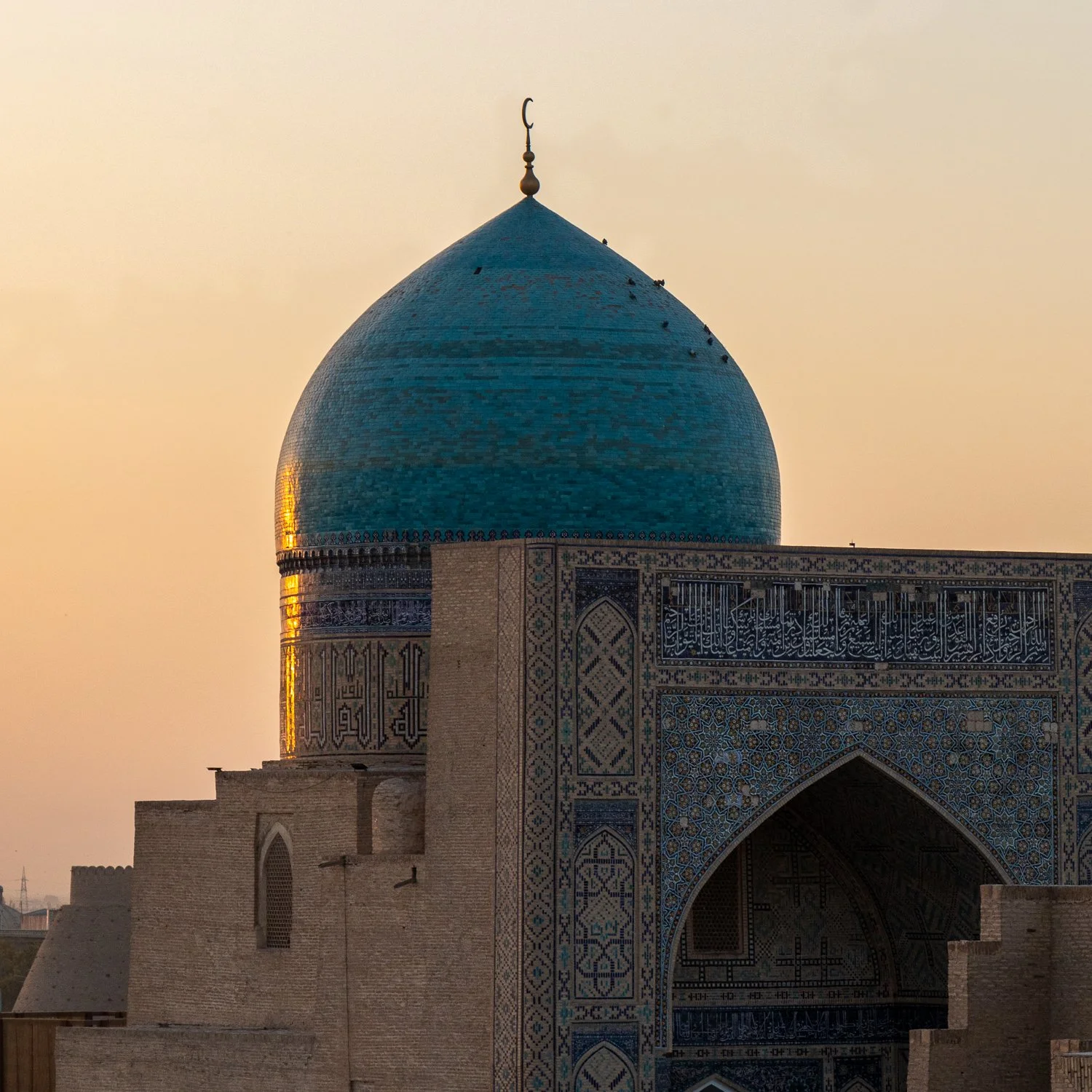
Kalan Mosque -literally “Big Mosque” in Farsi- was built between the 12th and 15th centuries and was renovated beginning in the late 20th century.
Later in the evening I made my way over to Po-i-Kalan (sometimes written as Kalyan), a square surrounded by some of Bukhara’s most significant religious buildings. Thankfully, the square was mostly empty (or, rather, significantly more empty than it was during our orientation walk) and I stuck around a bit to take some pictures.
Two more photographs from my sunset walkabout follow.
3. Mir-i-Arab Madrasa
Dating to the 16th century, the Mir-i-Arab Madrasa was one of the few madrasas allowed to operate in the Soviet Union, and is Bukhara’s only presently operating Islamic college.
4. Kalan Mosque Sunset #2
5. Po-i-Kalan Sunset
Po-i-Kalan is the name of the square comprised of the Kalan Mosque, Kalan Minaret, and Mir-i-Arab Madrasa; it received extensive damage during the 1920 Bukhara Operation by the Soviet Russians aimed at rooting out anti-Socialist resistance in the city.
Having met up with members of my tour group, we headed to the rooftop bar at the Minorai-Kalon Hotel, adjacent to Po-i-Kalan and a great place to grab and drink and view the sunset.
Three additional photos from the rooftop follow.
6. Kalan Mosque Sunset #3
7. Kalan Minaret Sunset #1
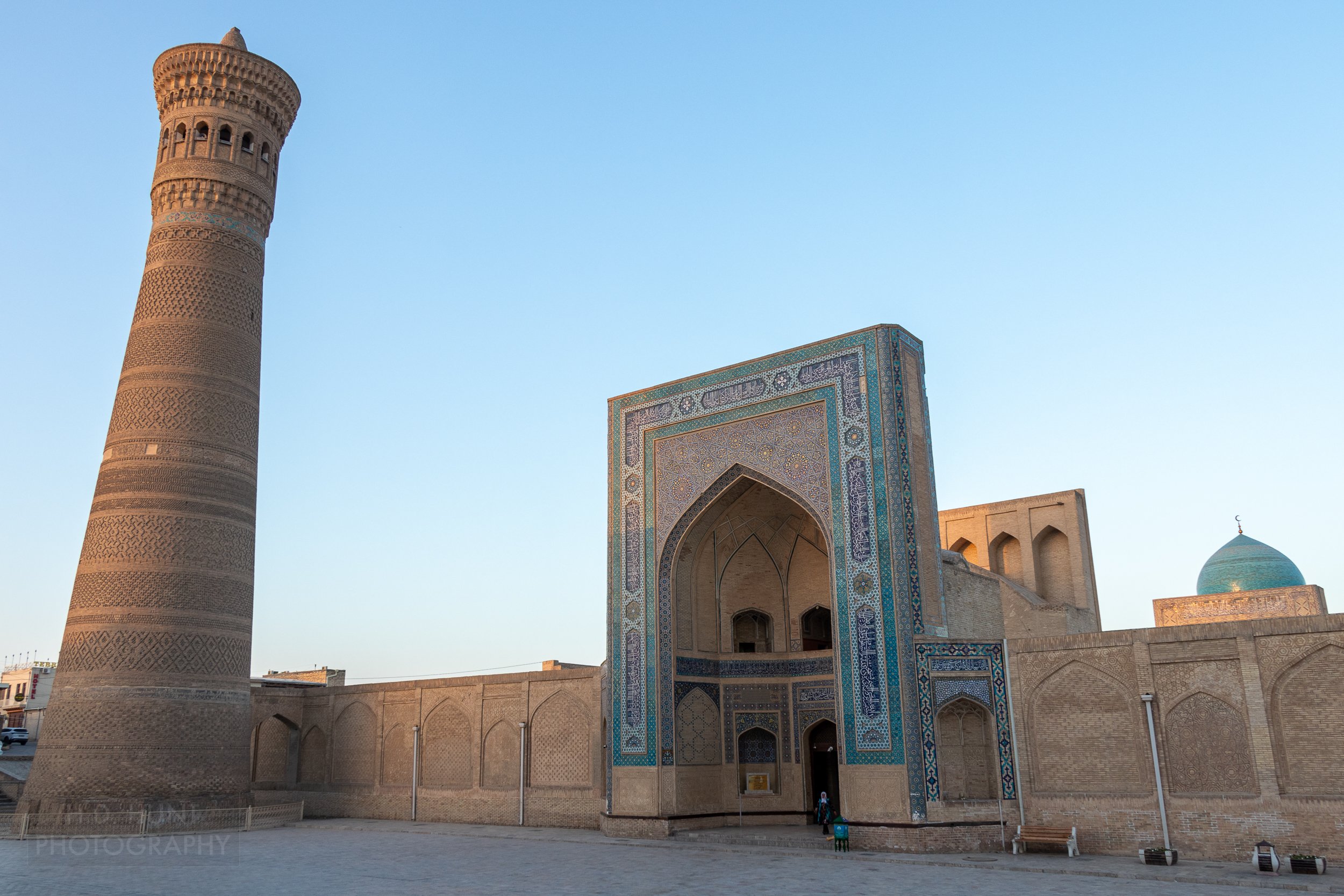
The Kalan Minaret stands 46 meters / 150 feet tall and was constructed in the 12th century; so impressed was Genghis Khan by the tower that he spared it during his sack of the city.
8. Kalan Minaret Sunset #2
There is an interesting tale concerning the tower’s builder, Bako: upon setting the tower’s base, he disappeared for several years (two or three, depending on the account), after which he returned to continue construction, justifying his hiatus by saying the tower would be more stable if the base had a long period of time to cure.
(I haven’t any real idea where the balloon came from, it just sort of showed up.)
9. Nodir Devonbegi
Nodir Devonbegi was constructed in the 17th century as a place of worship for practicians of Sufism.
Feeling extremely grateful and relieved after a credit-card-for-cash dinner with very understanding tour group members (a long story I won’t waste space on retelling other than to say to Capital One: nobody -and I mean literally nobody- wants a useless Discover-branded ATM card), I called it an evening, having resolved to get up in the morning to photograph the city before our in-depth group tour. Waking well before breakfast, I zig-zagged my way back towards Po-i-Kalan in the so-called “golden hour.” If you are in Bukhara and want to get immaculate photographs of this UNESCO World Heritage Site, I cannot recommend this strategy enough.
Eighteen photographs from my morning walk follow!
10. Lab-i Hauz
A hauz (“howz” in Farsi) is a small symmetrical pool primarily for bathing; the Soviet Union filled in most pools due to the spread of disease, but Lab-i Hauz survived.
11. Toqi Sarrofon #1
Toqi Sarrofon is one of Bukhara’s largest trading domes and was constructed in the 16th century; it was originally intended for money traders.
12. Toqi Sarrofon #2
The central dome of Toqi Sarrofon is 12 meters / 39 feet tall.
13. Bukhara Streets #1
Between 2017 and 2025, Uzbekistan spent $6.5 billion on tourist infrastructure; Uzbekistan welcomed 2.7 million visitors in 2017, and recently announced their goal of 20 million visitors by 2030.
It was at this moment on my morning walk -as I stared at this very door on this very wall- that a thought occurred to me: the whole of Bukhara’s historic center feels like it has been clinically rebuilt. Now, to be clear I don’t really mean this as a complement: this reconstruction appears less for the sake of meticulous historic preservation, and more for the sake of tourist-friendly sterility. Frankly, this notion should be a bit unsettling - after all, shouldn’t an ancient Silk Road city have a bit more wear and tear? The best way I can describe it is as the tourism version of an uncanny valley: reality here seems a bit off, and once you see it, you cannot unsee it.
Is this true, or is this just a matter of flawed perspective? Regrettably, I’m not the only one who seems to think the former to be the case. In researching this phenomenon further, I came across an excellent guest post written by Dr. Gulnoza Usmonova on the Ajam Media Collective which suggests that Bukhara suffers from a condition called “staged authenticity.”
To dig a bit deeper: in 1973, Dean MacCannell published an article in the American Journal of Sociology outlining this concept which -for lack of a better summation- defines the circumstances driving the paradoxical creation of inauthentic tourist spaces to satisfy tourists desire for authenticity. A quote from the article does a good job of conveying this idea:
Touristic consciousness is motivated by its desire for authentic experiences, and the tourist may believe that he is moving in this direction, but often it is very difficult to tell for sure if the experience is authentic in fact.
In the article, Dr. Usmonova discusses the transformation of Bukhara’s historic center from a place belonging to the residents of Uzbekistan’s seventh-largest city to a place now belonging to primarily international visitors, exploring what impact this has had on local businesspeople and Bukhara’s culture. Suffice it to say, Dr. Usmonova’s writing marry up with my on-the-ground observations as a fairly well-traveled and admittedly skeptical foreigner.
Honestly, I challenge any foreign visitor to Bukhara’s historic center to have one genuine cultural or social interaction with a local because I bet you’d be hard-pressed to do so. Furthermore, I challenge you to find any signage or historical marker which goes beyond describing what you are looking to explain why you should be looking at it. Simply put, Bukhara now only exists as an aesthetic.
So, what is the cause of this phenomenon? In the case of Bukhara, economics is no doubt driving this decision. Since 2017, Uzbekistan’s government has been spending incredible amounts of money to attract tourists, originally setting a visitation goal of 15 million visitors by 2030, since upwardly revised to 20 million in November 2025. This is manifested best by the Eternal Bukhara project, which will serve no other purpose than to exacerbate this state of staged authenticity.
Now before you call me out as a hypocrite, I will freely admit that by visiting Bukhara I contributed to this problem. All I can do now is warn you that 1) all is not as it seems here, and 2) we should be working towards demanding more legitimate travel experiences rather than rewarding inauthentic ones.
This is a shame: no amount of gentrification or government investment can take away form Bukhara’s historical importance, and -regardless of its dubious historicity- the city is quite pretty to look at. But it seems Bukhara’s soul has all but departed, and if you want to get a glimpse of it before it is gone forever, your time is running short.
14. Bukhara Archaeological Site
Salt Carried by the Wind is a joint Indian-Uzbek art installation-cum-pavilion featuring enamelware and ceramics atop a functioning kitchen building.
15. Toqi Sarrofon #3
Bukhara Biennial is an art festival inaugurated in September 2025, featuring art installations across the city, such as this textile display.
16. Bukhara Streets #2
While so-called “Bokhara rugs” and their deep red colors are now associated with Turkmen traders, their origins are from the city which gave them their name; today, the rich weaving tradition continues and many carpet shops can be found across the city.
17. Toqi Telpakfurushon #1
Toqi Telpakfurushon was constructed in the 16th century and features a unique hexagonal central merchant area underneath its main dome.
18. Toqi Telpakfurushon #2
Hate A.I generated content? So do we!
Support our mission to show the real world with a follow on Instagram.
Thanks for your support!
19. Ulugh Beg Madrasa
The Ulugh Beg Madrasa -built in 1417- is the oldest madrasa built by Ulugh Beg and one of three he built currently preserved.
20. Kalan Mosque Sunrise #1
21. Kalan Mosque Sunrise #2
22. Kalan Mosque Sunrise #3
23. Kalan Mosque Sunrise #4
24. Kalan Minaret Sunrise
25. Kalan Mosque Sunrise #5
26. Toqi Zargaron
Toqi Zargaron is the largest of Bukhara’s four trading domes, historically reserved for jewelers.
27. Toqi Telpakfurushon #3
28. Samanid Mausoleum #1
The Samanid Mausoleum was constructed between the 10th and 11th centuries and was the final resting place of at least three individuals.
After breakfast at the hotel (featuring the only reliable coffee machine in the whole of Uzbekistan), we boarded our tour bus to begin our walking tour of Bukhara. We’d start at the Samanid Mausoleum, far on the edge of the historic center, and work our way back to the hotel on foot. For better or worse, it seems like a lot of other groups had the idea to start at the Mausoleum, as well, and the tiny building was packed!
29. Samanid Mausoleum #2
The Samanid Mausoleum is one of the best existing examples of an early Islamic funerary structure.
The mausoleum’s interior is super cramped, a problem compounded by large tour groups.
30. Ferris Wheel on a Brisk Morning
The Samonids Recreation Park was constructed by the Soviet Union atop an ancient cemetery.
We passed the Samonids Recreation Park on the way back to the city, which is the only faintly Soviet thing I recall seeing in the whole of Bukhara.
31. Bolo Hauz Mosque #1
Dating to 1712, the Bolo Hauz Mosque features multiple muqarnas-topped slender wooden columns supporting its covered entrance.
We made a quick stop at Bolo Hauz Mosque, but did not have a chance to go inside.
32. Bolo Hauz Mosque #2
33. Bukhara Ark #1
The Ark of Bukhara has had several incarnations since the 5th century, but has fundamentally remained a large walled-off residence for the royal courts of Bukhara; today it houses primarily a series of museums covering history, culture, and the environment.
Entrance to the Bukhara Ark was included as part of our tour. Inside was a series of well-meaning but disjointed museum exhibits, as well as an unfortunately back-lit view over Bukhara’s historic center.
34. Bukhara Ark #2
The majority of the structures seen today at the Bukhara Ark were built within the last few centuries.
35. Kalan Mosque #1
We then walked over to Kalan Mosque, admittance to which was also included in the group package (in case you are curious why I didn’t enter the two other times I had been here….) Thankfully it wasn’t super crowded inside and the mosque’s large courtyard prevented the claustrophobia that’s unfortunately common at sights in Uzbekistan.
36. Kalan Mosque #2
37. Kalan Mosque #3
38. Kalan Mosque #4
39. Kalan Mosque #5
40. Kalan Mosque #6
41. Abdulaziz Khan Madrasa
Built in the mid-17th century, Abdulaziz Khan Madrasa forms an architectural ensemble with the Ulugh Beg Madrasa across from it.
We had a couple of other quick stops on our walking tour, stopping inside Ulugh Beg and Abdulaziz Khan Madrasas before heading over to the Bukhara Synagogue and the Nodir Devonbegi Madrasah. I know by this point I was pretty mosque-and-madrasa’d out, and I expect some if not most of my travel companions felt the same way. As such, I retired to my hotel for a while before rejoining the group for dinner at a nearby restaurant.
Oh, in case you needed any more affirmation that Bukhara is the poster-child of staged authenticity: the restaurant was in a converted madrasa.